
THE MANY LANGUAGES OF THE BODY — Autism, Diagnoses and Symbolic Expression — Field-Reading, week 47
This week, I have been reflecting deeply on the many languages through which the human body communicates, and on how much we still have to learn from those whose lives do not fit into the patterns we have come to accept as normal. I am speaking about autism, diagnoses, disabilities, chronic illness, and the children refer to as Sweet Special Children. Throughout my years of working with people, I have encountered so many different expressions of human life, where I see disorder as an invitation to look more closely at the environments, expectations, and systems we have created around one another. What happens when a human being cannot adapt to the world we have constructed? Do we immediately assume that something is wrong with that person, or are we willing to examine the world that is asking us to become someone we are not?
We have become accustomed to organizing human life through categories. We identify symptoms, establish diagnoses, measure development, and compare people against what we have decided is normal. These processes can be enormously valuable, particularly when they help people receive understanding, appropriate treatment, practical support, and protection from unnecessary suffering. Yet a diagnosis can never tell us everything about the person who carries it. It cannot fully describe how someone experiences the world, what they perceive, how they communicate, what they need, or what their presence may teach the people around them. I believe we lose something profoundly human when we become so occupied with identifying what is different that we stop being curious about the life expressing itself through that difference.
We can also learn a great deal from The Telepathy Tapes, including its explorations of consciousness, communication, and its latest season, which explores reincarnation. These stories have brought me back to questions I have carried for many years: What is the soul? What does it bring into a human lifetime? And how much of our existence can be understood through the experiences of one physical body alone? I find this deeply meaningful, as it invites us to consider the possibility that human consciousness is far more complex than the frameworks through which we currently attempt to understand it.
Within my understanding of reincarnation, the soul moves through different lifetimes, gathering experiences and encountering patterns that may continue until they are understood, integrated, or transformed. Some souls, have travelled through many earthly experiences, while others carry fewer of the accumulated patterns that shape human identity and behavior. I describe this through the expression symbolic density: the layers of memory, conditioning, emotional experience, and karma that influence how we perceive ourselves and the world. This is a spiritual language, and I do not use it to suggest that a person’s diagnosis reveals the age, purity, or spiritual development of their soul. No diagnosis can tell us that. What interests me is different forms of perception and presence that our familiar ideas about human development do not yet adequately describe.
When I speak about the Monad and Divine Design, I am referring to our original essence, the luminous source of being that exists beneath the identities and patterns we accumulate throughout life. This essence is not something we have to manufacture. It is something we gradually learn to recognize, remember, and embody. I have sometimes encountered children and adults whose ways of being have reminded me of this extraordinary simplicity of presence, as though they were inviting everyone around them to become more attentive, more truthful, and more deeply connected. In these relationships, I acknowledge what their presence awakens in me, and how profoundly they have sometimes challenged my assumptions about intelligence, communication, awareness, and love.
Much of humanity lives is happening through repetition. We wake up, follow familiar routines, respond through old emotional patterns, repeat the same conflicts, defend the same beliefs, and continue building institutions upon ideas that have been handed down for generations. We call this stability, progress, and civilization, even when the systems themselves produce enormous suffering. We become so accustomed to our own patterns that we rarely question the structures beneath them. And then someone enters our lives who cannot live comfortably within those expectations. A child who experiences sound, touch, movement, or social interaction differently. A person whose body demands a different rhythm. Someone whose way of communicating requires us to slow down, become more observant, and listen beyond spoken language. Suddenly, the patterns we have been repeating no longer work as they once did.
I see these encounters as invitations to examine ourselves. When a child struggles in a classroom, we must ask what support that child needs, but we should also be willing to question the classroom. When a person becomes overwhelmed by noise, demands, or relentless expectations, we should listen to what their experience reveals about the conditions in which they are expected to live. When someone communicates without conventional speech, we need to develop more respectful and reliable ways of understanding what they are expressing. The responsibility cannot always rest upon the individual to become more like everyone else. Sometimes the responsibility belongs to the family, the school, the workplace, the healthcare system, and the wider society to become more responsive to human diversity.
I think particularly about the Sweet Special Children. I use these words with affection, although I also understand that every child deserves to be recognized as an individual, and that many autistic and disabled people prefer other ways of describing themselves. These children are not here to carry our spiritual expectations, and their difficulties should never be romanticized or overlooked. Some experience significant pain, communication barriers, sensory distress, or disabilities that require lifelong support. Their needs are real, and they deserve care, accessibility, dignity, and every opportunity to participate in life. At the same time, I believe we must be careful that our desire to help does not become a demand that they abandon their own ways of experiencing the world. We can offer support while remaining open to what their differences reveal about the limitations of our systems.
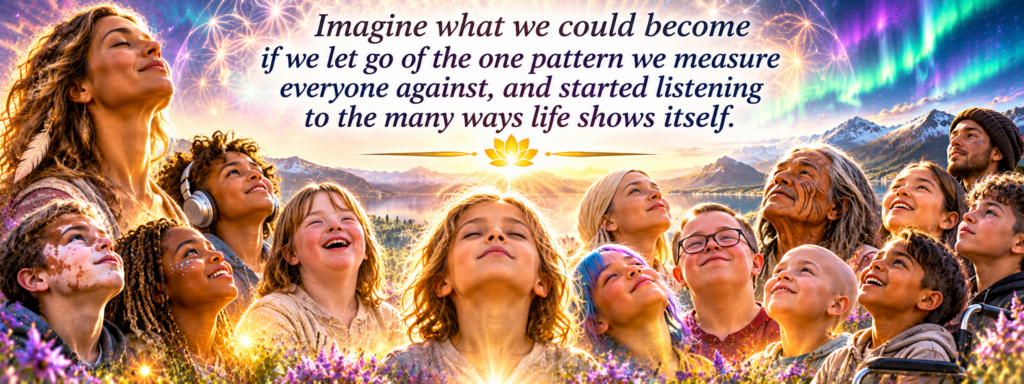
The future of humanity will depend upon our willingness to recognize that intelligence, consciousness, and human worth cannot be measured through a single standard. We have become so committed to efficiency, productivity, conformity, and constant achievement that we have forgotten how to live in relationship with the full diversity of life. We have created systems in which many people are exhausted, disconnected from their bodies, separated from nature, and struggling to maintain a sense of belonging. We continue repeating patterns that damage our relationships, our communities, and the Earth itself, while calling upon individuals to adapt to conditions that may be deeply unsuitable for them. When I look at this, I understand why so many people feel that something fundamental must change.
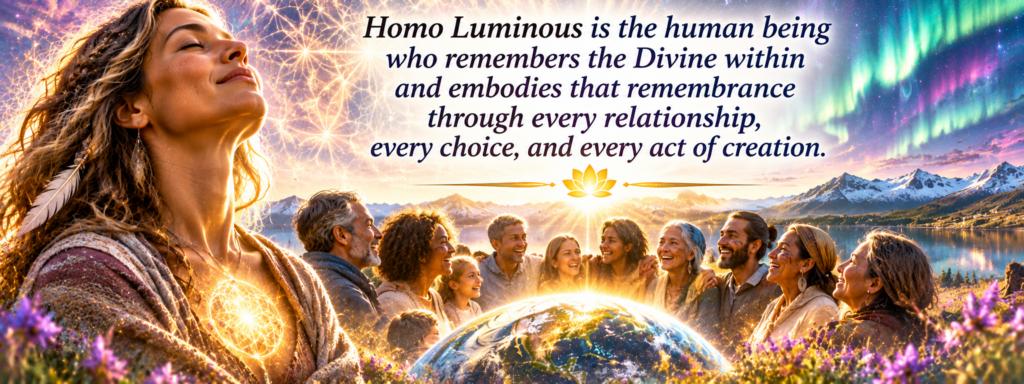
This is also where Homo Luminous enters the conversation. Homo Luminous represents a possibility for humanity to live with greater consciousness of our interconnectedness, to recognize the divine essence within life, and to create relationships and systems that honor rather than suppress the diversity of human expression. I envision a future in which we become more attentive to the wisdom of the body, more responsible for the environments we create, and more willing to question the patterns that have shaped our collective existence. This future requires us to listen carefully to those who have so often been excluded from defining what a meaningful human life should look like.
There is a profound difference between trying to understand another human being and trying to make that person fit into our existing understanding. The first requires curiosity, humility, patience, and love. The second can become an endless struggle in which the individual is repeatedly told, directly or indirectly, that their natural way of being is unacceptable. I have seen how deeply human beings can suffer when they are misunderstood, and I have also seen how much can change when someone finally feels recognized. Sometimes a different environment, a different relationship, or a different way of communicating can open possibilities that were previously hidden beneath years of frustration and distress.
As I move through this week’s Field-Reading, I keep returning to the question of what our bodies and our differences are asking us to notice. Illness deserves proper medical attention, and disability should never be treated as evidence of spiritual failure or as something a person has chosen in order to teach others a lesson. Yet our encounters with illness, difference, and vulnerability can still transform the way we understand life. They can expose the limits of our assumptions, deepen our compassion, and invite us to build a world in which more people can genuinely belong. I believe the transition toward a more conscious humanity will require precisely this kind of listening, where we become willing to learn from experiences that do not resemble our own.
One of the greatest challenges before us is to recognize how much of the suffering we see around us has been intensified by the ways we organize human life. We have built remarkable systems of knowledge, medicine, education, and technology, and yet we have also created environments that leave many people feeling invisible, overwhelmed, or excluded. We have become skilled at identifying differences, while still struggling to understand how to live together with them. If we are serious about creating a different future, we must begin by listening to the people whose experiences reveal where our present systems are failing.
This week, I invite you to look more deeply at the many languages of the body and at the people whose ways of perceiving, communicating, and living may be very different from your own. Listen to their experiences. Listen to their needs. Listen to what they are telling us about the world we have created, and about the world we still have the possibility of creating together.
With love from 69° North,
Ann-Peggy Divine