
Architecture of a Living Ethos – A Relational Framework for Life, Health, and Responsibility
Living the Architecture of Life
If The Architecture of Light explores the cosmological foundation of reality, and The Architecture of Future Medicine brings this understanding into the body, The Architecture of a Living Ethos takes the next step: it explores how this same architecture is lived in everyday life.
This book examines what it means to live as a relational being within a living universe. It asks how human choices, attitudes, language, and relationships influence not only society but also biology, health, and the wider field of life.
Rather than presenting a moral system or a set of rules, the book introduces the idea of a living ethos—a way of being that naturally arises when human beings recognize themselves as participants in the web of life.
In this view, ethics is not imposed from outside. It emerges from relationship.
An Invitation into Relationship
It began with a peace lily.
It stood on the table in our living room, quiet, the way plants stand. I turned my awareness toward it, toward the space between breaths, and allowed myself to enter into relationship with it. My awareness merged with the plant’s field. Thought fell away. Sensation became finely tuned, light, and clear, and my body felt almost weightless, filled with subtle vibrations of light. There was no ecstasy in it, only a calm, high-frequency presence. There was no longer a plant and me. There was the relationship, and within it I experienced the life of the plant from the inside, a self-organizing system in perfect regulation.
The same movement carried me further, into the conifer forest and into a great tree, where I experienced from the inside how insects fed on the leaves and the bark, and how what looked like destruction was life changing form. It carried me down into the interior of the Earth, through the movement of magma and the fire of the volcano, and on into the slow cycle of stone over millions of years. Each time I entered into relationship, I became one with what I met, and each time life showed me the same thing: nothing is lost. Everything is alive, and everything exists in relationship.
This is what this book is about. Relationship is not something we think our way into. It is a doorway to direct experience, where we become one with what we meet and know life from the inside. This book is written out of such encounters, and it is written so that you may find your way to your own.
You do not need to understand everything, and you do not need to agree with everything. It is enough to be in dialogue with what is touched in you.
When the text moves into the body’s matrices, you can let your attention sink down into the body. When it describes the realms of life, you can notice how nature is already present in your own life, perhaps in a plant on the windowsill. When it speaks of field, relationship, and resonance, you can sense how this is already at work in your relationships, in your choices, in your moods, and in your stillness.
Some chapters will feel explanatory, others like mirrors. Some like correction, others like confirmation.
Life’s intelligence cannot be forced. It opens when the relationship is right. So it is with a peace lily, with a forest, and with a human being, and so it is with this book. You are therefore invited to enter into relationship with it, in the same way it invites you into relationship with your body, with nature, with other people, and with the field that connects all life.
Welcome in.
Professional readers Kathleen Scully and Colin Whitby share their reflections on The Architecture of Light, The Architecture of Future Medicine, and The Architecture of the Living Ethos, offering an in-depth perspective on the impact and depth of these works.
What This Book Explores
Through 44 chapters, The Architecture of the Living Ethos develops a relational framework for understanding how human life unfolds within a living universe.
The book explores the idea that human beings are fundamentally relational, biologically, emotionally, socially, and ecologically. Our health, our perception, and our collective systems are deeply influenced by how we relate to the world around us.
The reader is introduced to the 13 Matrix system, which describes layers of relational intelligence within the body and the wider field of life. These matrices serve as organizing structures through which perception, regulation, and interaction take place.
From this foundation, the book expands into a broader exploration of the realms of life, including the mineral, plant, animal, human, elemental, and field dimensions of existence. Each of these realms is presented as a living participant within the relational architecture of Earth.
The later chapters explore how language, emotion, environment, sound, and vibration influence biological regulation and the atmosphere of human relationships.
Gradually, the reader is guided toward a deeper understanding of how everyday life itself becomes the place where coherence, responsibility, and participation in the living field unfold.
Themes in the Book
Within the pages of The Architecture of the Living Ethos, readers encounter themes such as:
- the shift from rule-based ethics to relational responsibility
- the human being as a fundamentally relational organism
- indigenous perspectives on relationship with nature
- the body as a sensing participant in a living universe
- the intelligence of the elements and the natural world
- the 13 Matrix architecture of human life
- communication between the realms of life
- the influence of attitude, language, and emotional climate on biology
- the role of environment and resonance in health and coherence
The book reveals how life already operates through relationship, resonance, and participation.
A Relational Way of Being Human
The Architecture of the Living Ethos invites the reader to rediscover a deeper orientation toward life. In this orientation, illness is understood as correction, communication becomes relationship and responsibility becomes participation. Human beings are participants within a living field of intelligence that includes the body, the Earth, and the wider cosmos.
Living in alignment with this architecture requires attention, presence, and a willingness to enter into relationship with life itself.
Buy the Book
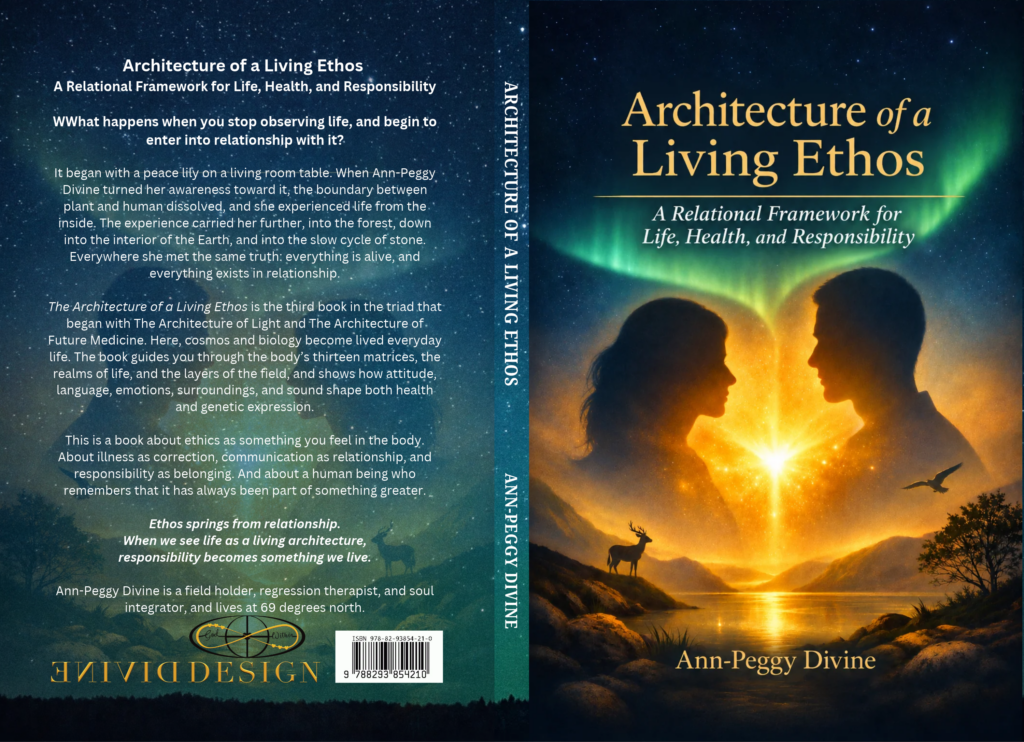
The Architecture of the Living Ethos — A Relational Framework for Life, Health, and Responsibility
This book is part of the Architecture Series by Ann-Peggy Divine, exploring the deeper architecture of consciousness, the living body, and the relational intelligence that connects humanity with the Earth and the wider cosmos.