

The Lens I Live From
I do not experience life as a linear sequence of events, nor as something confined to one lifetime.
To me, life is a continuous field of creation — where past, present, and future are woven together through experience, memory, and choice.
What we call “time” is not separate compartments, but an unfolding dialogue.
Experiences carried in one life do not disappear. They seek completion, understanding, and integration — often through new circumstances, new bodies, and new relationships.
We incarnate into families, cultures, and situations that allow these dialogues to continue. Not as punishment, and not as fate, but as opportunity. We meet one another again — sometimes as helpers, sometimes as mirrors — because there is something unfinished that wishes to be lived through fully.
The Body as Memory
From this perspective, the body is not only biological. It is also a carrier of memory.
I was born with a congenital heart condition. The first two years of my life were critical, marked by repeated hospitalizations and a physical vulnerability that was understood purely as medical defect. There was a hole between the chambers of my heart — a weakness that shaped my earliest relationship with life.
Over time, and through lived inquiry rather than belief, I came to understand this heart vulnerability differently. My heart did not carry only physical fragility. It carried sorrow, loss, and unresolved experiences from other lifetimes — including experiences of violence, deep emotional trauma, and a life in which my heart had been fatally wounded.
What had once been understood solely as biological malfunction revealed itself as structural embodied memory. The body remembered what the mind could not.
A Life Before and a Life After
The first forty years of my life were shaped by illness, survival, and an ongoing attempt to make sense of a body under strain. This lived reality formed the foundation for my first book, The Health Bible – Think With Your Heart
That book reflects a life lived from within the physical body — at the collapse of ego identity — where health, pain, and resilience were understood through direct experience rather than theory.
What followed was not improvement, but rupture. The death of the ego marked a profound shift in how life was known. From that point on, the focus was no longer on fixing the body, but on understanding coherence — how life organizes itself when fear, control, and survival-based identity fall away.
This shift gave rise to the books that followed:
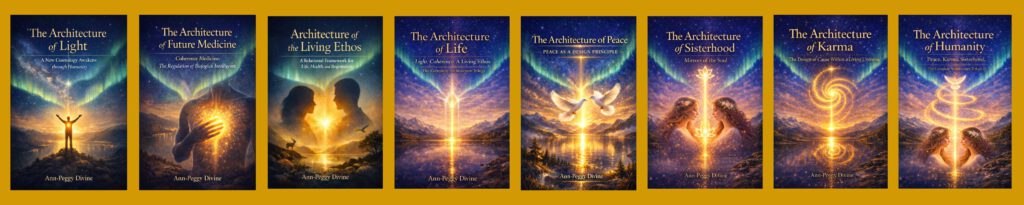
- The Architecture of Light – A New Cosmology Awakens Through Humanity, exploring the luminous architecture of life and cosmos.
- The Architecture of Future Medicine – Coherence Medicine: The Regulation of Biological Intelligence, articulating a new understanding of health rooted in regulation rather than intervention.
- The Architecture of the Living Ethos, describing how coherence extends into relationship, responsibility, and collective life.
- The Architecture of Life – Light. Coherence. A Living Ethos. The Complete Architecture Trilogy, integrating the first three architectural works into a unified framework describing the foundations of a coherent human life.
- The Architecture of Peace – Peace as a Design Principle, presenting peace not as an ideal, but as the structural condition required for sustainable human systems.
- The Architecture of Karma – The Design of Cause Within a Living Universe, examining how actions, intentions, and relational dynamics shape the unfolding patterns of life.
- The Architecture of Sisterhood – Mirrors of the Soul, exploring the transformative power of feminine relational fields and the role of women as holders of collective coherence.
- The Architecture of Humanity – Peace. Karma. Sisterhood. The Complete Architecture Trilogy II, expanding the architecture into the relational and collective dimensions that shape the future of human civilization.
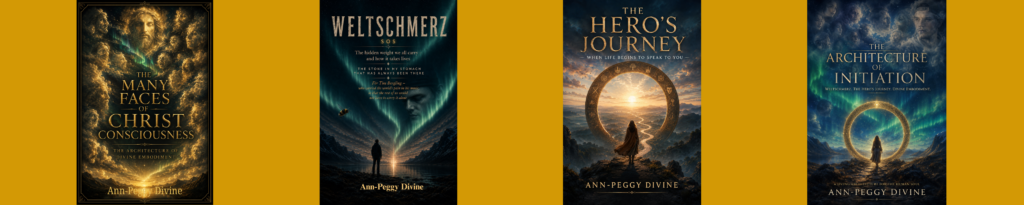
- Weltschmerz – The Hidden Weight We All Carry — And How It Takes Lives, exploring the silent burden of collective and personal suffering, and revealing how unprocessed emotional pain shapes our health, relationships, and the choices that determine life itself.
- The Many Faces of Christ Consciousness — The Architecture of Divine Embodiment, exploring Christ Consciousness as a universal architecture of human awakening, revealing the shared wisdom that unites spiritual traditions through embodied presence rather than belief.
- The Hero’s Journey — When Life Begins to Speak to You, presenting the Hero’s Journey as a living process of initiation, demonstrating how life’s greatest challenges become invitations to transformation, purpose, and the remembrance of our authentic nature. – A FREE smal EBOOK
- The Architecture of Initiation – Weltschmerz. The Hero’s Journey. Divine Embodiment., integrating the three works into a unified framework describing the timeless journey from human suffering to divine embodiment through the universal process of initiation.
These works are reflections of a life lived on the other side of collapse.
Programs as Integration, Not Method
Alongside the books, several experiential pathways have emerged through the same lived inquiry — including the Hero’s Journey, the Spiral of Grace, DNA Detox & Recalibration, Monad Integration, and the 13-module Divinima-Reset.
These are not systems to follow or techniques to master. They are structured spaces for integration — designed from direct experience of how the body, psyche, and relational field reorganize when old patterns complete.
Their purpose is not transcendence, but embodiment. Not escape from life, but the capacity to meet life more fully. They exist to support the slow reorganization that occurs when survival structures soften and the nervous system returns to coherence.
Lives Are Not Isolated
In my understanding, no life stands alone. Experiences of abuse, grief, betrayal, or violence do not disappear simply because a life ends. They remain as unresolved movements within the larger relational field of existence. They seek resolution — not through punishment or repetition, but through recognition, understanding, and completion.
One life marked by prolonged abuse and exploitation ended with my own death at the age of nineteen. That surrender did not vanish. It became part of a deeper field of experience that later required integration, forgiveness, and understanding.
Nothing is lost. Everything returns — not as judgment, but as invitation. What we create, we eventually encounter again. What we judge, we must one day understand from within. These insights form part of the inquiry explored in The Architecture of Karma – The Design of Cause Within a Living Universe.
Life Beyond Survival
Much of my work now speaks to Homo Luminous as the natural consequence of integration — the human being that emerges when life is no longer organized around survival. When the pain-body is no longer directing perception, something quieter becomes possible: a life grounded in coherence rather than reaction.
The books currently unfolding — including The Architecture of Karma, The Architecture of Sisterhood, The Architecture of Life, and The Architecture of Humanity — explore different dimensions of this transition.
Together they investigate how cause and consequence shape experience, how feminine relational fields sustain life, how coherence organizes biological and social systems, and how humanity itself may evolve when survival consciousness loosens its grip.
Life as Self-Encounter
From where I stand now, life is not something that happens to us. It is something we meet ourselves through. Every experience is precise — not moral, not punitive, but relational. We encounter what we have created because, at some level, we wish to understand it fully.
Healing, then, is not erasure of the past. It is remembering without distortion.
This is the cosmology I live from. Not as belief — but as lived experience.