
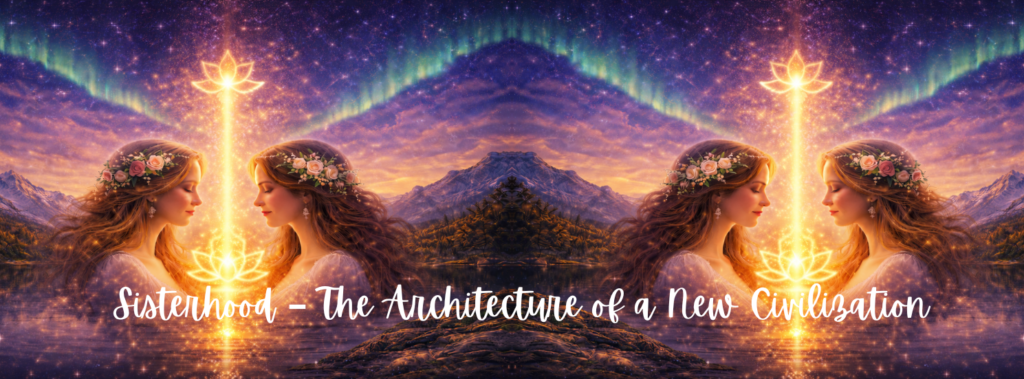
Sisterhood – The Architecture of a New Civilization
A Living Order of Rhythm, Relation, and Conscious Creation
What if sisterhood is not only a relationship between women, but a forgotten architecture for how human beings were originally meant to live together?
Sisterhood – The Architecture of a New Civilization explores sisterhood as far more than friendship, biology, or social identity. It reveals sisterhood as a living field of consciousness, a relational intelligence, and a stabilizing force capable of restoring coherence within both individuals and collective systems.
At the heart of this book lies a deeper understanding: humanity does not heal through control, competition, and fragmentation, but through relationship, resonance, rhythm, and conscious participation within the living field of life itself.
Throughout history, many societies have organized themselves through hierarchy, separation, and external power structures. This book explores another possibility. A civilization built not upon domination, but upon coherence. Not through force, but through attunement. Not through rigid systems, but through living relational intelligence.
Within this perspective, sisterhood becomes more than emotional support between women. It becomes a field where human beings learn reflection, responsibility, truth, emotional regulation, rhythm, healing, and conscious creation through relationship itself.

“Sisterhood is where the soul learns to see itself through another woman’s eyes.”
The book explores how women have historically carried relational and energetic functions within communities, families, rituals, and collective transitions, and how these forgotten capacities are now re-emerging as essential foundations for the future societies humanity is beginning to move toward.
Through themes such as feminine leadership, collective awakening, Ma’at, sacred law, cyclical societies, technology and consciousness, Atlantis and pre-Egyptian memory architecture, soul remembrance, future education systems, relational healing, and Homo Luminous, the book weaves together spirituality, psychology, biology, consciousness, ancient wisdom, and future civilization into one living architecture.
A central thread throughout the work is the understanding that human beings are not isolated individuals, but participants within interconnected fields of relationship that continuously shape perception, health, identity, and collective reality. Sisterhood therefore becomes both deeply personal and profoundly civilizational.
The book also explores the seven sister archetypes — different relational functions that naturally emerge within coherent feminine fields — revealing how balance arises not through sameness, but through complementary roles, rhythms, and unique expressions of being.
At its deepest level, this work is about remembrance.
A remembrance that the body carries intelligence.
That rhythm carries order.
That relationship carries healing.
That consciousness shapes reality.
And that humanity may now be standing at the threshold of a new form of civilization rooted not in hierarchy, but in living coherence.
This is not presented as ideology, belief, or dogma, but as an exploration of what becomes possible when human beings begin to organize life in alignment with the deeper principles of resonance, relation, and conscious creation.
The book grows out of lived experience, women’s circles, ceremonies, deep relational processes, and years of exploration into consciousness, health, regulation, and human development. It is both visionary and deeply grounded, offering not only philosophical perspectives, but an embodied framework for how future systems may begin to emerge through the transformation of human relationship itself.
Sisterhood – The Architecture of a New Civilization is part of the Architecture Series by Ann-Peggy Divine, a body of work exploring the deeper structures behind consciousness, biology, ethics, human development, and collective evolution. Within this series, this book explores how sisterhood may function as one of the foundational architectures for the emergence of a new human civilization.