

THE BODY’S OWN RESET — Field-Reading, Week 38
Last week I tested my capacity. This week my body answered. During Week 37, I lived in an extreme rhythm for several days. I spent the daytime with family and continued ordinary life, while working through the nights, sleeping only somewhere between thirty minutes and an hour during each twenty-four-hour period. What fascinated me was that while I was inside it, I felt remarkably capable. My body carried me, my mind remained active, and I continued doing what needed to be done. But capacity in the moment does not necessarily tell us the whole story of what something costs the body. When Week 38 arrived and the external pressure disappeared, my body changed the agenda completely.
I had plans for this week. After three months working within the healthcare system, I was ready to return to my own rhythm, my writing, my creative work and everything I want to bring into the world. Instead, my body asked for sleep, stillness and recovery. I began waking during the night with a strong sensation of activity and tenderness around the kidney area, and I experienced the entire week as a profound reset. Rather than fighting it or forcing myself immediately back into productivity, I surrendered to what my body was asking from me. I supported myself with rest, nourishment and dandelion root, which has a long history of traditional herbal use.
THE BODY REMEMBERS THE COST
There is something important here that I think many of us misunderstand. We often measure our capacity by what we are capable of doing while we are doing it. We say, I managed it. I got through it. I was strong enough. But the body keeps another account. Modern physiology calls one part of this constant balancing process homeostasis: the body’s continuous regulation of its internal conditions. Sleep itself is deeply involved in physical repair, immune function, metabolism and healthy brain function, which makes recovery after severe sleep loss a biological necessity.
This week reminded me that there is a difference between capacity and sustainability. The fact that we can carry something does not automatically mean that carrying it has no consequence. We can function through stress, responsibility, crisis and lack of sleep for a period, particularly when something requires us to keep moving, but eventually the body asks to be included in the conversation. Sometimes it whispers through tiredness or subtle imbalance, and sometimes it changes the plan so completely that our only intelligent response is to listen.
For me, this became particularly meaningful through the kidneys and through the much older understanding of the body found in Traditional Chinese Medicine. In the Five Element tradition, the Kidney system belongs to Water and winter and is associated with Jing, or Essence — the deep constitutional foundation connected with growth, development and vitality. Fear is traditionally associated with the Kidney system as well, particularly prolonged or excessive fear.
I find the symbolism profoundly relevant. Water moves downward. Winter withdraws. Nature does not remain in permanent summer, producing endlessly without returning energy to the roots. There is a season for flowering and there is a season for restoration. There is a time for extending our branches into the world and a time when life pulls us back toward the foundation that makes those branches possible. This week, my body took me back to the roots.
WE ARE NOT ONLY BRANCHES
This morning I woke to frost. Ice covered the cars and the ground, and suddenly the changing season was visible everywhere around me. Autumn has arrived here in the north, moving toward winter, and I could not ignore the synchronicity between what was happening outside my window and what I had been experiencing inside my body.
I kept seeing the image of a tree. Our body is not only its visible branches. It has roots, a trunk and an entire hidden architecture that supports everything we see above the surface. Yet much of modern life encourages us to focus on the branches: How quickly can I return to work? How can I remove this symptom? How can I regain my energy? How can I continue producing? The deeper question is different:
What is happening at the roots?
This question became even more important because Week 38 also marks the end of three months in which the healthcare system has been my daily habitat. I have spent enormous amounts of time there, often more waking hours at work than at home, surrounded by people who are ill, vulnerable and dependent upon care. But also by professionals carrying tremendous workloads inside systems that are under pressure. I have witnessed exhaustion, constant demands, infections circulating through shared environments, organizational difficulties and people repeatedly trying to manage the next urgent situation before the previous one has truly settled. After three months, I can feel how deeply an environment enters our experience.
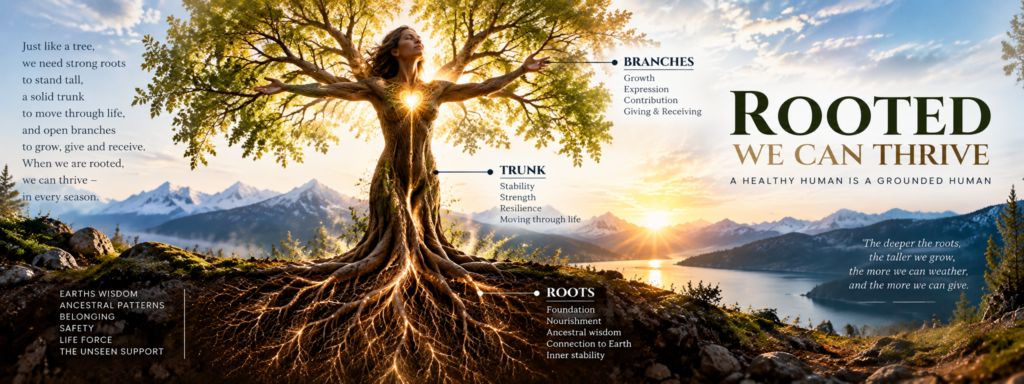
THE HABITAT ENTERS US
A habitat is not simply the address where we live. It is everything we repeatedly expose the organism to: the air, microorganisms, noise, light, food, sleep conditions, workload, relationships, stress, safety and rhythms surrounding us. Highly sensitive people literally absorb other person’s unresolved emotional patterns into their organs, where our environment absolutely affects our physiology, nervous system and behavior.
This is why I have become increasingly interested in what I call habitat health. We often ask what is wrong with the individual without asking what kind of environment the individual is continually adapting to. A person can work endlessly on their wellbeing while spending most of their life inside an environment characterized by chronic stress, insufficient recovery, noise, conflict, poor sleep or constant overstimulation. The body has to respond to the habitat in which it actually lives, not the habitat we wish it lived in.
The same principle applies beyond workplaces. For some people, large cities provide belonging, stimulation and opportunity; for others, constant noise, crowding, pollution or sensory demand can become exhausting. Another person may flourish in the same environment. The important question is not whether one habitat is universally good or bad, but whether we have become sensitive enough to recognize what our own body does in the environments we repeatedly inhabit.
Our bodies are extraordinarily responsive instruments. They register rhythms, relationships, temperature, light, sleep, nourishment, threat and safety long before the thinking mind has created a story about what is happening. That does not make every sensation an infallible message, but it does mean that embodiment requires us to pay attention.
THE BODY AS A SACRED TEMPLE
This is where the experience of Week 38 has taken me. I have spent much of my life exploring consciousness, but consciousness is not something that happens somewhere outside the body. Everything I experience in this human life reaches me through this extraordinary biological instrument. I touch through it, love through it, create through it, grieve through it, sense the world through it and bring everything I am here to create into physical form through it.
For me, that makes the body sacred. Calling the body a sacred temple does not mean believing that we can control illness through consciousness or that every symptom carries a spiritual meaning. Bodies become ill. Infections happen. Genetics matter. Accidents happen. Medicine matters.
But reverence for the body does mean accepting responsibility for the conditions we can influence. What do I feed this body? How much sleep do I give it? What environments do I repeatedly place it in? What pace do I demand from it? Which signals do I continually override because they interfere with my plans?
I entered Week 38 ready to move forward. My body moved inward. Instead of demanding that it follow my agenda, I allowed my agenda to follow the body for a while. And this is the deepest lesson I am carrying from these days: the body does not exist merely to carry the mind wherever the mind has decided to go. There are moments when wisdom means allowing the intelligence of the body to determine the pace.
So I leave you with three questions this week:
Do you listen to your body when it asks you to stop, or do you continue pushing until it forces you to stop?
What happens in your body in the environments where you spend most of your life — does your habitat restore you, regulate you and support you, or are you constantly recovering from it?
And when your body takes you back to the roots, can you honor that movement before demanding that it produce new branches?
I tested my capacity in Week 37. In Week 38, my body taught me something about the cost of capacity, the necessity of restoration and the intelligence of returning to the roots. The frost arrived outside my window at the same time. A new season has begun. And this time, I am listening.