
Download the first 5 chapters of The Architecture of Karma FREE in English and Norwegian
Nothing returns to harm. Everything returns to complete.
What you have seen begins to live the moment you no longer try to understand it.
Ann-Peggy Divine
Stories That Reveal the Patterns
Throughout the book, the principles of karma are illustrated through real and practical examples. Some of these examples come from the author’s own life, others from experiences shared within families, communities, and across generations. The book also explores how karmic patterns may move through family lines, relationships, and collective histories, sometimes revealing connections that stretch far beyond what we normally consider the boundaries of time and space.
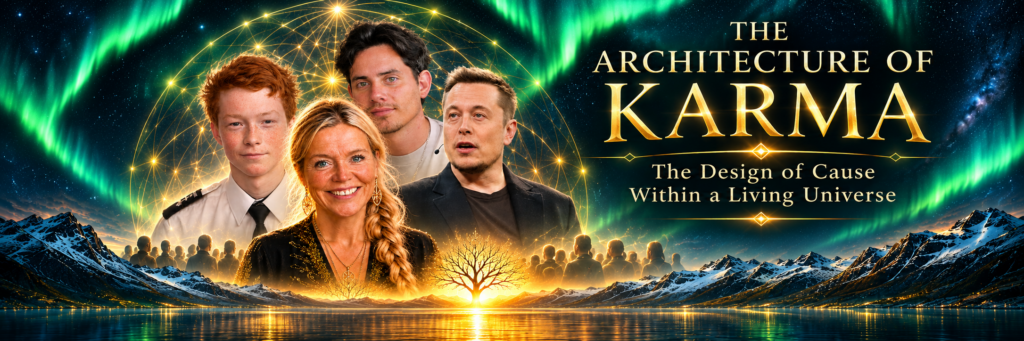
Two well-known figures are given chapters of their own, as living illustrations of how differently karmic architecture can organize itself. Through Elon Musk’s family structure, the book explores a modern, multi-nodal spiral, where several relational streams exist at once and weave together into a larger whole. Through Matias De Stefano, it explores the opposite expression, a singular and focused architecture that expands not through a large family, but directly into humanity as a whole. Side by side with the author’s own family spiral, these examples show that there is no single correct way for life to organize itself.
These examples show how the threads of cause and consequence are often deeply intertwined. They demonstrate how choices made in one moment may ripple through relationships, environments, and even generations.
By looking at karma through everyday situations and lived experience, the book reveals how the architecture of cause is constantly present in ordinary life, as a practical reality that shapes how we live, relate, and evolve.

NORWEGIAN
I Karmaens Arkitektur inviterer Ann-Peggy Divine deg til å se det som allerede er i bevegelse i ditt eget liv. Med utgangspunkt i levd erfaring, blant annet den fortsatte forbindelsen med sønnen Aleksander etter at han forlot kroppen sin i 2015, viser hun hvordan det vi kaller karma, ikke er noe som følger oss, men noe som beveger seg gjennom oss og søker balanse, integrasjon og uttrykk.
Gjennom 36 kapitler og seks deler beveger boken seg fra grunnlaget for karma som arkitektur inn i energi, syklisk tid, aktivt minne og sjelens kontinuitet. Den utforsker familien som en levende karmisk codex, fødselens og inkarnasjonens arkitektur, persepsjonens sju nivåer og hvorfor utfordringer vender tilbake til de blir møtt. Derfra åpner den seg mot integrasjon som fullføring, hellig gjensidighet med Gaia, gjenkomsten av eldgammel visdom fra Atlantis og Egypt, Ma’at og fremveksten av Homo Luminous, et menneske som ikke lenger styres av ubevisst gjentakelse.