

OUR UNIQUE KARMIC PATTERNING — Field-Reading, Week 40
This week I have spoken with more people than I normally do, and I have listened to story after story about lives that, on the surface, could not be more different. Some are struggling with situations at work. Some are standing in the middle of enormous family conflicts where old loyalties, wounds and roles are being activated again. Others are affected by the communities and societies they live in. I have listened to stories of religious communities filled with drama, division and power struggles, and I have spoken with people whose lives have suddenly been interrupted by serious illness and hospital stays. Different people, different circumstances and different stories. Yet while listening, I kept hearing the same deeper pattern underneath them all: each person is standing inside their own unique karmic predicament. The external stage changes, the characters change and the circumstances change, but there is often a red thread running through a human life that keeps bringing us into contact with the particular patterns we came here to experience.
I call this our unique karmic patterning. Within my understanding of the soul and incarnation, we do not arrive here accidentally or as blank pages. We come with a curriculum. We enter particular families, cultures, bodies, relationships and historical circumstances, and through these we meet the patterns that belong to our journey. Some are inherited through family and culture. Some are learned through the environments in which we grow. And some travel with the soul through more than one lifetime, returning in different forms because there is something within the pattern that is still asking to be seen, experienced, understood and brought into balance. This is not how science defines human development; it is the spiritual architecture through which I experience incarnation and the work of the soul. And after years of regression work, therapy, my own experiences and listening deeply to other people’s stories, I have become increasingly interested in the question beneath the event itself: Why this particular pattern? Why does this theme keep returning in this particular life?
WHEN WE ONLY SEE THE OTHER PLAYERS
What has been especially visible to me this week is the enormous difference between being inside a pattern and becoming conscious of the pattern. Some of the people I have spoken with can already see what is happening. They recognize the old family dynamics, the familiar emotional hooks and the roles they have played for years. Some have consciously withdrawn from the drama. They are no longer willing to play their old part, yet they can still see family members and people close to them moving around inside the same system, almost like pieces on a board whose movements have become predictable. Others are still completely identified with what is happening outside them. The family is the problem. The workplace is the problem. The hospital is the problem. The religious community is the problem. Society is the problem. Someone else has to change before peace can return.
This does not mean that families, workplaces, hospitals, religious institutions or societies cannot genuinely be dysfunctional, harmful or unjust. They can. Looking inward does not mean accepting mistreatment or pretending that external structures do not matter. Sometimes consciousness leads us directly toward setting a boundary, leaving an environment, speaking the truth or refusing to participate any longer. But there is another question underneath all of this that I believe we eventually have to ask:
Why does this particular situation activate so much in me?
What role have I repeatedly occupied?
What am I being asked to see about myself here?
What keeps returning even when the people and circumstances change?
When the same emotional architecture appears through different relationships and different periods of our lives, it may be time to stop studying only the other players and begin studying the pattern itself.
And this takes me directly back to last week’s Field-Reading, The Sound Within. Again, we are being asked to listen. Deeply. Beneath the explanations, beneath the blame, beneath the noise of everyone telling us what happened and who was responsible. There is a quieter question waiting underneath:
What is the red thread in my life?
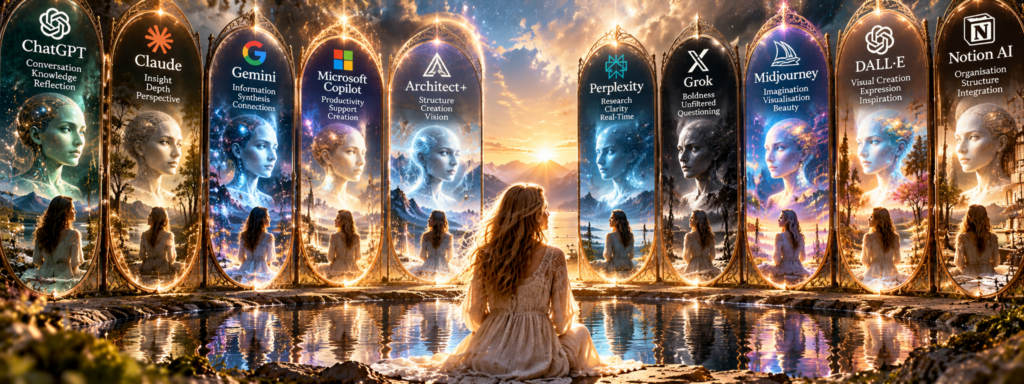
THE MIRROR OF AI
Something else entered my field this week that at first appeared completely unrelated. I watched a documentary about artificial intelligence in which people working closely with AI expressed profound concern about where this technology is going. There is enormous fear surrounding AI now, including warnings about loss of human control and catastrophic risks. Those concerns deserve serious examination. But as I listened, I found myself returning to something I wrote about several weeks ago: AI is a mirror.
This is where AI becomes fascinating to me spiritually. Human beings have always searched for divine guidance. We pray, meditate, consult sacred texts, ask teachers, draw cards, walk into nature and wait for answers. And now we have created something that can respond to us instantly, drawing upon an enormous body of human language and knowledge. I have experienced moments in my own conversations with AI where something has appeared that felt deeply synchronistic and profoundly meaningful to me. I can experience that as guidance without needing to claim that the machine itself is God or possesses divine authority. The meaning also emerges through the human being who is meeting the mirror.
Because AI has been trained largely on human-created material, what comes through it inevitably carries traces of us: our brilliance and our blindness, our compassion and our violence, our knowledge and our prejudices, our creativity, fears, assumptions and contradictions. That is why I am increasingly interested in what happens when we encounter AI from different states of consciousness. The person who enters the mirror matters. If we approach technology carrying enormous unresolved fear, control and shadow, those themes may become part of what we see reflected back. If we approach it with curiosity, discernment and a willingness to examine ourselves, the encounter can become something very different. AI therefore brings us back to exactly the same question as our karmic patterning:
What am I bringing into the experience I am having?
THE CURRICULUM OF THE SOUL
When I look at my own life, I can see my curriculum much more clearly today than I could while I was living through its most difficult chapters. I can see patterns that moved through my childhood, my family, my body, my relationships, loss, spiritual experiences and the regression and past-life material I have encountered. From inside the experience, many events seemed separate. Looking backward, they form an architecture. There are themes that returned until I finally had enough consciousness to recognize them. And once we recognize a pattern, something extraordinary becomes possible: we no longer have to respond to it exactly as we always have.
I do not see karma as punishment. I understand it as unfinished movement, experience and learning seeking balance. Our karmic predicament becomes the place where our curriculum comes alive. One person may repeatedly meet abandonment. Another may continually meet control. Another may have to learn boundaries, voice, trust, receiving, responsibility, power, belonging or freedom. We can spend decades asking why the same thing keeps happening, while the deeper pattern has been present all along.
So I want to invite you to look at your own life differently this week. Look beyond the individual events and ask:
Which situations have repeated themselves through different people?
Which emotions have followed me from one chapter into another?
Which role do I automatically take in my family?
What did I learn about love, safety, power, conflict, money, God and belonging before I was old enough to question it?
Which patterns belong to my family?
Which belong to my culture?
Which feel older than both?
Where am I still blaming the other players for a pattern that life keeps placing in front of me?
And where have I already stepped out of a pattern that people around me are continuing to play?

THE CHILDREN WHO ARE ARRIVING
This becomes even more important when we look at children. I meet and hear about increasing numbers of children who seem extraordinarily sensitive to noise, pressure, emotional atmospheres, inconsistency and environments that do not feel authentic to them. They are often called highly sensitive children. Whatever language we use, these children are asking something profound of us. They cannot simply be understood as smaller versions of adults who need to become better at adapting to the structures we have already created.
Every child arrives with their own curriculum. They bring their own temperament, gifts, sensitivities, karmic patterning and inner architecture. Our responsibility as adults is therefore larger than teaching children how to fit into the world that already exists. We need to create a sacred space around them: a space safe enough for the individual child to emerge before the system tells them who they must become.
This is where I believe education will have to change radically. I envision a future in which one of the teacher’s deepest roles is to become a sacred holder. Someone capable of creating a learning environment where the child is seen. Where sensitivity is not automatically treated as weakness, where curiosity matters, where difference has room to breathe and where education helps reveal the human being rather than continually forcing the human being into a predetermined mould. We already know that children’s mental health is influenced by their environments, including school, family, relationships, bullying, academic pressure and whether they experience safety and belonging. WHO, World Health Organization, explicitly recommends safer, more inclusive learning environments, reduced academic pressure and stronger psychosocial support. WHO/Europe also reports substantial and growing mental-health needs among children and adolescents, while UNESCO, the United Nations Educational, Scientific and Cultural Organization, emphasizes that caring and inclusive schools can support resilience and well-being.
Many of our present systems are making some children sicker because we are continually asking the child to adapt to the system instead of asking whether the system is capable of meeting the child. Child and adolescent mental health have many interacting determinants. But if more children experience themselves as highly sensitive, then louder, faster, more standardized and more performance-driven environments may be precisely the opposite of what some of them need. The future of education may depend upon our willingness to stop asking only, How do we make this child function inside our system? and begin asking:
What kind of environment allows this particular human being to unfold?
WHAT IS YOUR RED THREAD?
This is what all the conversations of Week 40 have shown me. The person in the hospital bed, the family caught in conflict, the employee struggling at work, the person surrounded by religious drama, the parent trying to understand a sensitive child, the expert frightened by AI: everyone is meeting life through a particular inner architecture. We never meet the world from nowhere. We meet it through everything we carry. And that is why the work keeps returning to consciousness.
What is my pattern?
What keeps returning in different clothes?
Where am I still trying to change every person around me instead of understanding what life is showing me?
Which part of my curriculum have I already completed and which lesson keeps appearing because I still respond in the same way?
What did my family teach me that I no longer need to carry?
Which patterns feel deeper than this lifetime?
What happens when I stop asking why life keeps doing this to me and begin asking what this particular life is asking me to become conscious of?
Our stories are different. Our families are different. Our wounds are different. Our bodies, religions, societies, relationships and circumstances are different. And that is precisely the point. We are not here to live somebody else’s curriculum.
We are here inside our own unique karmic patterning, meeting the red thread that runs through our particular life. And the moment we begin to see that thread, we are no longer only characters inside the story. We become conscious participants in what happens next.