
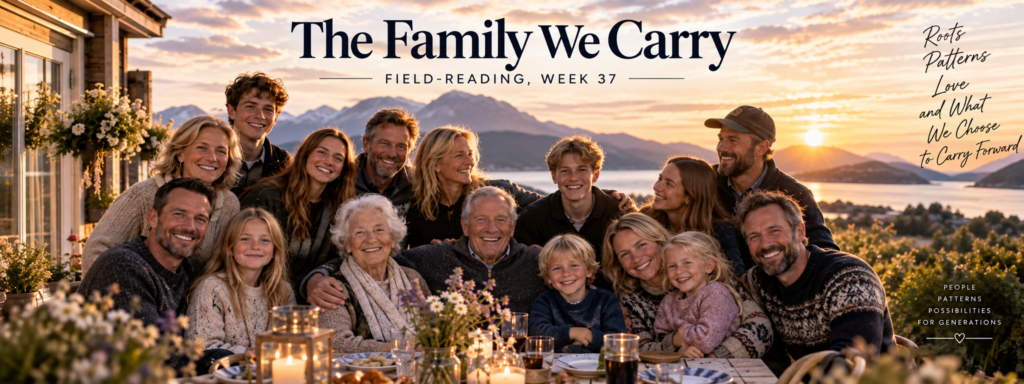
THE FAMILY WE CARRY — Field-Reading, Week 37
This weeks life seems determined to place the same theme in front of us everywhere we turn. For me, this has been one of those weeks, and the theme has been impossible to miss – Family.
My own family has been gathered. All our adult children have been home, my husband’s family has come together to celebrate his parents turning eighty and an extraordinary sixty years of marriage, and on September 12, Sten Magne and I celebrated 28 years of marriage ourselves. We have been sitting together, talking, remembering, celebrating and looking at the patterns that have travelled through our families, from our grandparents and parents, through us, and now toward the generations coming after us.
At the same time, I have encountered family from a very different direction. Through my work with people who need care, I have spoken with relatives trying to improve the circumstances of someone they love, and I have been reminded that even when a person lives in an institution and professional systems have taken responsibility for much of their daily care, family can still matter enormously. A relative who notices, asks questions, follows up and advocates can sometimes see something a large system overlooks. Family cannot replace professional responsibility, but it can remain an important voice beside a vulnerable person, especially when systems become fragmented or communication fails.
And beyond all of this, I have watched other families around me going through profound upheaval. Old conflicts are surfacing. Brothers and sisters are taking different sides. Things that have remained hidden for years are suddenly being spoken aloud. People are grieving because relationships they believed would always remain intact are breaking apart, and beneath the visible disagreements there often seems to be something much older moving through the room. All of this has made me return to one question:
What is it that we actually carry when we carry a family? We inherit more than a name.
We are born into stories that began long before we arrived. Before we understand language, we are already learning how our family works. We learn whether emotions can be expressed or must be hidden, whether conflict is approached or avoided, whether food becomes comfort, whether vulnerability is safe, whether love must be earned, whether someone always takes responsibility for everyone else, and whether difficulties are met with honesty, silence, blame, humor, control, withdrawal or care. Nobody necessarily sits us down and teaches us these things. We absorb them through living.
A child watches, senses and adapts. Eventually, what began as adaptation can become so familiar that we no longer experience it as a pattern at all. We simply call it me. This is one of the reasons I call this week’s Field-Reading The Family We Carry, because leaving the house in which we grew up does not necessarily mean leaving its patterns behind. We can move thousands of kilometers away, build a completely different life and still discover, decades later, that certain ways of responding to fear, intimacy, conflict, money, food, responsibility or belonging have travelled with us.
Some of what travels with us is beautiful. We inherit resilience, humor, values, recipes, traditions, stories, ways of caring, the ability to work, the capacity to survive and the memory of people whose lives made ours possible. But we can also carry what was never healed. And eventually, life may ask us to distinguish between the two.
When food becomes more than food
I know this intimately through my own story. For approximately ten years during my adolescence and early adulthood, I lived with bulimia and anorexia. Food was not simply nourishment. It became part of the way I regulated what I could not yet regulate emotionally, and when I later began looking more deeply at my family history, I could see that my relationship with food did not exist in a vacuum. There were patterns around food, regulation, control and coping that belonged to a larger family story.
This does not mean that one person’s eating disorder can be reduced to ancestry, because human beings are far more complex than that. Biology, psychology, environment, relationships and individual experience all interact. But it taught me something important: sometimes what feels intensely personal is also connected to something larger than the individual.
The same question has appeared when looking at patterns of diabetes in my husband’s family. There we can see another kind of inheritance, where genetic susceptibility, lifestyle, environment and family habits can interact across generations. This is where I find epigenetics particularly interesting, although I think we need to speak about it carefully.
Our genes are not simply an unchangeable script dictating every detail of our future. Gene expression can be influenced by environmental conditions and biological processes throughout life, and researchers continue to investigate how some environmentally influenced biological effects may reach across generations. This does not mean that every emotional or behavioral family pattern is literally encoded in our genes, but it does challenge the old idea that inheritance is simply a fixed destiny handed to us at conception.
Inheritance is real. Destiny is something else. We inherit conditions, vulnerabilities, environments and family cultures. And we inherit stories and strategies. But consciousness gives us the possibility of entering into relationship with what we have inherited rather than simply repeating it.
When the family shadow comes to the surface
There is another side of family patterns that has been particularly visible around me this week, and it is much more painful. Families are breaking apart.
Old stories are being reopened, accusations are being made, people who once stood together are choosing different sides, and emotions that may have accumulated over years are erupting into the present. For the people standing inside such a rupture, this is not an interesting spiritual concept. It hurts. When a sibling becomes an adversary, when parents and children stop speaking, or when the people we expected to remain our safest place become the source of profound distress, the loss can feel almost physical. In these situations, I often see two very different human movements.
One is outward. We locate everything that is wrong in somebody else. We point toward the person who caused our pain, build our case, repeat the story, gather allies and become increasingly certain that if only the other person changed, apologized, admitted what they had done or finally understood us, we could be free. The other movement is inward, and it is much harder. It asks:
What belongs to me here?
What is being activated within me? What pattern am I repeating? What am I contributing to this dynamic? What boundary have I failed to create? What truth have I avoided? What can I actually take responsibility for?
I do not believe consciousness means accepting mistreatment, and I do not believe every family rupture can or should be repaired. Sometimes the most responsible action available to us is a clear boundary. Sometimes love requires distance. Sometimes reconciliation is possible only when more than one person is willing to participate honestly. But there is an enormous difference between acknowledging that another person has caused harm and building our entire identity around being the person to whom harm was done. Responsibility begins when we ask what remains within our power now.
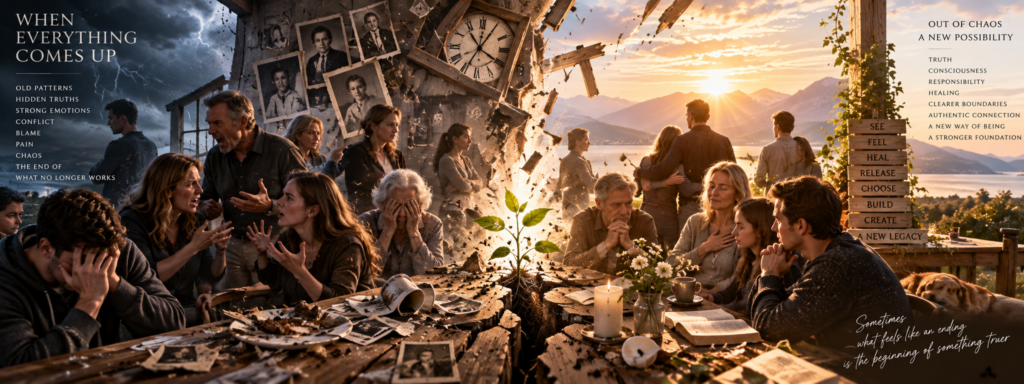
When everything comes up
I have often used the language that everything is coming up, and family is one of the places where we experience this most intensely, because family relationships reach so deeply into our sense of identity and belonging. When old structures begin to change, what has been hidden underneath them becomes visible. That can look like chaos and failure. It can feel as though the family is being destroyed. But sometimes a system becomes unstable precisely because the old way of holding it together no longer works.
This does not guarantee transformation. A family can become more entrenched in blame and division. People can repeat the same wounds for another generation. But disruption can also create an opening where something previously unconscious finally becomes impossible to ignore. And this is where the individual choice becomes so important.
We cannot awaken an entire family by force. We cannot make another person take responsibility. We cannot heal a sibling’s wound for them. We cannot force somebody to look inward simply because we can see their pattern. What we can do is become increasingly conscious of the part of the family story that lives through us. And sometimes that changes more than we realize.
When our own family structure collapsed
Sten Magne and I know something about this. September 12th, 2026 we celebrated 28 years of marriage, but the two people celebrating that anniversary are not the same two people who stood together 28 years ago. At one point in our life together, I entered my Hero’s Journey. The identity I had constructed and inherit, the ways I had survived and many of the patterns through which I had understood myself began to collapse. It was not a graceful spiritual transformation where one identity quietly disappeared and a wiser version of me emerged in its place. It was painful.
And because we were a family, my transformation did not happen only to me. When one person inside a family system changes profoundly, every relationship around that person is affected. The agreements we never knew we had made with one another begin to change. The roles no longer fit. The familiar ways of creating stability stop working. My life collapsed, and eventually Sten Magne entered his own Hero’s Journey as well.
His journey was not mine. His process unfolded through his own life and his own patterns, but for a period it felt as though almost everything upon which we had built our identities was being dismantled at the same time. There were pain, ruptures and uncertainty. And our children were living inside that family system too, which means that our transformation inevitably affected them.
This is one of the realities we sometimes forget when we speak beautifully about healing and transformation: when one person changes, a whole relational system may have to reorganize around that change. It can be enormously difficult. But today, looking back, I can also see what became possible because we did not simply rebuild the same structure. We became different. Our relationship became different. And our family became different.
We can speak about patterns now that once controlled us from underneath the surface. We can recognize when something old is being activated. We can hold more space for one another when life becomes difficult, without immediately needing to fix, control or escape what is happening. We have not become a family without patterns. We have become a family that can increasingly see them. And there is tremendous strength in that.
The ancestral table
I found the celebrations in our own family particularly moving this week. Two people turning eighty, sixty years of marriage, children, grandchildren, partners and new generations. When we gather around a table like that, we are looking at far more than the people physically present. We are looking at consequences. One relationship created another relationship, which created another life, which eventually created another branch of the family.
Behind everyone sitting there are people who are no longer alive, grandparents and great-grandparents whose decisions, strengths, wounds and circumstances still echo in the lives that followed them. And ahead of the table are generations we may never meet. That gives family a strange and beautiful dimension. We stand in the middle of something. We did not begin the story, and we will not finish it. But for a while, part of the story passes through our hands.
The family we carry — and the family we create
I want to make an important distinction. We cannot choose what we inherited as children. But as adults, we increasingly participate in deciding what we carry forward. We can preserve the tenderness, humor, traditions, courage, devotion and belonging. And we can also say: The silence ends here, the shame does not need another generation, this way of handling conflict has travelled far enough, this relationship with food does not have to become my child’s relationship with food and this fear may belong to my history, but it does not have to determine my future.
Family does not necessarily mean repairing every relationship or getting everyone to agree. Sometimes healing means becoming the person who no longer unconsciously carries the same pattern forward. And that may be enough to change the direction of a lineage.
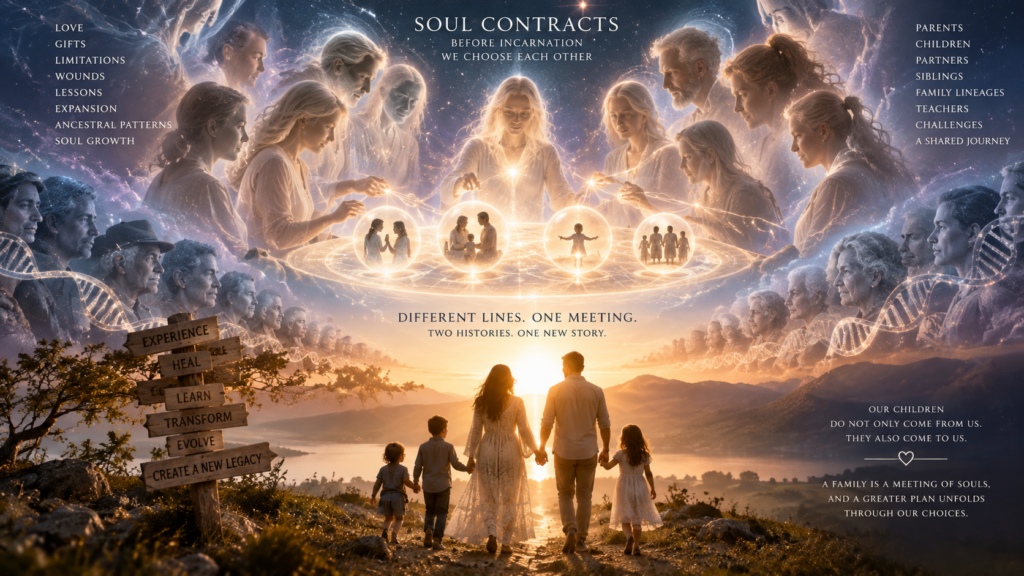
A deeper layer
There is another dimension to family that reaches beyond genetics, epigenetics and psychology and into the deeper architecture of the soul and incarnation. This belongs to a spiritual understanding of human life rather than something science can currently measure, and within this understanding, family is not random. We enter life through particular relationships because they carry the combination of love, gifts, limitations, wounds and ancestral patterns through which our soul has chosen to experience and evolve.
Before physical incarnation we have made soul contracts. We choose our parents, our children and the partners with whom we share our lives because they create a particular landscape for our development. Our children do not simply come from us; they also come to us, carrying their own journey while becoming some of our greatest teachers. And when we choose a partner, we meet not only that person, but an entire ancestral lineage that will meet our own.
When two people create a family, two histories meet. Generations of patterns, strengths, wounds and ways of loving enter the same relationship, and something new becomes possible. The patterns can continue unconsciously, or they can become visible enough to be transformed. This is why our closest relationships often activate us so deeply: family brings us close enough to love one another, but also close enough to reveal what we have not yet healed.
Some relationships give us belonging, while others teach us boundaries, responsibility, forgiveness or the courage to choose differently. Some family members enter a lineage at the point where something that has travelled through generations is ready to change. This does not mean that abuse should ever be tolerated or that suffering should be dismissed by saying, “Your soul chose this.” A soul contract never removes human responsibility or free will. Sometimes the transformation within a relationship is precisely learning to say no, creating a boundary, leaving what is harmful or refusing to carry an old pattern any further.
What will continue through us?
This is why family can be both extraordinarily beautiful and deeply challenging. We carry our ancestors within us, but we are not here simply to repeat them. We inherit stories, patterns, gifts and wounds that began before we were born, while consciousness gives us the ability to decide what happens when those patterns reach us.
When one person begins to change, the whole family system is affected. Old roles stop working, relationships shift, hidden tensions become visible, and what initially looks like chaos or everything falling apart can sometimes be the painful dismantling of a pattern that can no longer continue in the same form. We cannot force another family member to become conscious, take responsibility or look inward, but we can become responsible for what continues through us.
So the deeper question is no longer only: What family do I come from? It becomes: What family do I carry within me and what will continue through me?
What deserves to be honored? What needs to be healed? Which patterns have travelled far enough? And what do I want to place into the hands of those who come after me?
We cannot rewrite the lives of our ancestors, but we can become conscious of what their lives placed into ours. We can honor what gave us strength, transform what continues to create suffering, and consciously choose what we carry forward.
We inherited the family story, but we are not here only to repeat it. We are also here to participate consciously in what the story becomes next. And that is both the responsibility and the extraordinary gift of the family we carry.