
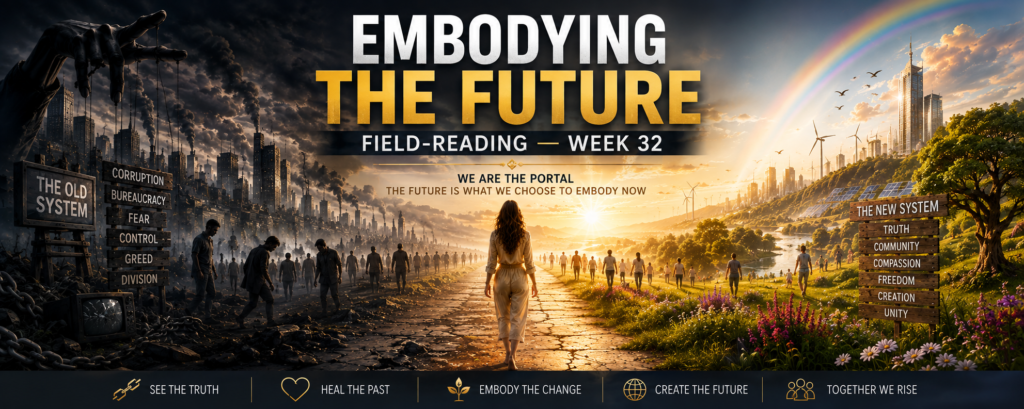
Embodying the Future — Field-Reading – Week 32
This week, much of the spiritual world is speaking about the 8/8 Lion’s Gate, about manifestation, energetic openings, higher frequencies and the possibility that something becomes more accessible to us when certain dates, symbols and collective beliefs converge. I understand why these moments become powerful, but my own experience continues to bring me back to something much more grounded: the most important opening is not happening somewhere outside us, in another dimension or somewhere beyond the body, but through human consciousness itself. We give meaning to these moments, we gather our attention around them, we strengthen them through intention, ceremony and shared belief, and in doing so we participate in creating the very opening we are waiting for. To me, this does not make the experience less spiritual; it makes it more profound, because it places responsibility back into our own hands. We are not merely waiting for cosmic energies to change our lives. We are conscious participants in creation, and eventually everything we awaken to has to travel all the way down into the body, into our relationships, into our workplaces, into the systems we inhabit and into the ordinary decisions we make when Monday morning arrives.
And Monday morning arrived very clearly for me this week. On August 3, I walked into work and was immediately met by crisis, practical problems and a situation that needed to change. There was nothing abstract or mystical about it. There were people who needed something better, practical obstacles that had to be solved, and an organization with many departments, routines, procedures and layers through which even relatively simple changes can sometimes become remarkably complicated. I work within Tromsø Municipality, and as I began calling different people to find a solution, I repeatedly encountered versions of the same answer: it could not be done now, it would cost too much, it would require approvals, it might take a week, a month or perhaps several months. Almost everywhere I turned, I met the gravity of a system that had learned to accept delay as normal, and for me this became such a clear illustration of what I mean when I speak about the old system meeting the new.
I did not want to fight the people inside that system, because the people do the best they can. Most of them are simply working within structures they inherited, following procedures they have been taught to follow and navigating complexity in the best way they know how. But neither was I willing to accept that complexity itself should become the reason nothing could move. So I continued calling, asking, explaining, searching for another possibility, and eventually I met two men whose response carried a completely different quality. Eivind Anker Lie, work manager at Dreis Production, and Tord Hagen at Kvaløya Hjemmetjeneste met the situation with helpfulness, openness and a willingness to find a solution, and within hours something that had repeatedly been described to me as difficult, expensive or painfully slow became possible. We were able to borrow the larger vehicle we needed and make practical improvements for a resident receiving municipal services. It was a relatively small event when viewed against everything happening in the world, but sometimes the smallest events reveal the largest principles, because what I witnessed was the difference between a human being protecting the limitations of a structure and a human being asking how the structure can actually serve life.
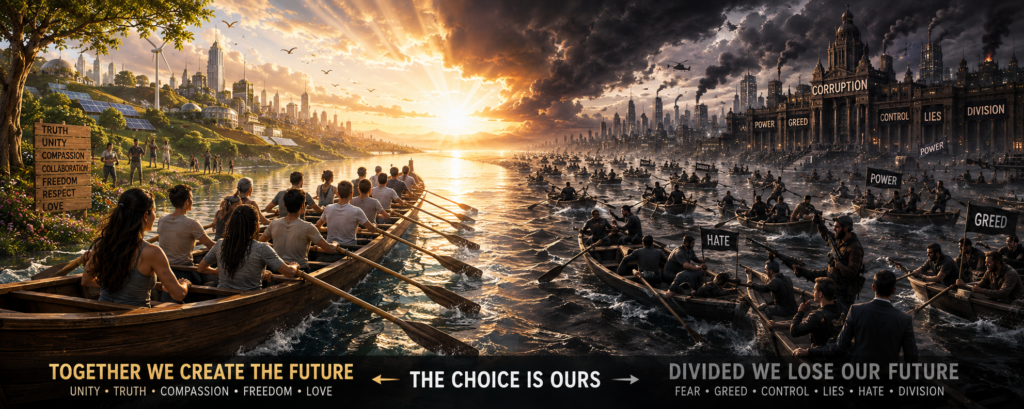
That experience brought me back to a vision I had in 2013, when I experienced very clearly that part of my path would involve changing systems. At the time, I could not possibly have understood what that would require of me, because I still imagined that changing a system meant somehow entering it from the outside and making it better. What followed instead was my own Dark Night of the Soul, years of dismantling, illness, loss, grief, questioning and transformation through which life seemed determined to remove everything in me that belonged to the very structures I thought I was going to change. Looking back now, I understand this differently. I could not become an alternative to an old system while carrying the same fear, obedience, fragmentation and survival patterns within myself. Before I could participate in creating something new, I had to become different myself. The Hero’s Journey was therefore not a detour from the work. It was preparation for it.
This is what embodiment means to me now. Embodiment is not having beautiful spiritual ideas while continuing to reproduce the same patterns in ordinary life. It is not speaking about higher consciousness while becoming paralyzed when resistance appears. It is not visualizing a new Earth while waiting for someone else to build it. Embodiment begins when what we say we believe becomes visible in the way we respond to an exhausted colleague, the way we treat a vulnerable person, the way we use authority, the way we challenge something that no longer works, and the way we continue searching for a solution after ten other people have told us there is none. We can meditate upon compassion for twenty years, but eventually compassion has to become something our hands do. We can speak about courage, but eventually courage has to enter the telephone call we are afraid to make, the conversation we would rather avoid and the moment when remaining silent would be easier than speaking. We can talk about the future endlessly, but at some point, the future has to acquire a body.
This is also why the contrast has felt so intense this week. Alongside my experiences at work, I had a long conversation with a man who told me about his previous work in policing and about the criminal environments and corruption he says he encountered and learned about while living and working in different European countries. His account was confronting. He described a world in which organized crime intersect with legitimate institutions, where money, threats and influence distort decisions, and where people working inside systems find themselves under enormous pressure. I cannot independently know the truth of every claim or experience another person shares with me. Yet the conversation stayed with me because the larger reality it pointed toward is undeniable: corruption, organized crime, coercion and abuse of power exist, and whenever fear makes ordinary people unwilling to look at darkness, darkness receives more room in which to operate.
There is an important distinction here, because bringing the shadow into the light does not mean becoming consumed by suspicion or deciding that everyone in authority is corrupt. That would simply create another form of unconsciousness. It means developing the maturity to look directly at what human beings are capable of creating when money becomes more important than life, when power becomes disconnected from responsibility, when loyalty becomes more important than truth, and when fear keeps good people silent. The darkness we encounter in society did not arrive from another planet. Human beings created it, participated in it, tolerated it, benefited from it or looked away from it, just as human beings have also created hospitals, schools, communities, art, music, acts of extraordinary generosity and systems of care. Both possibilities live within humanity, and any spirituality that can only look at the light while refusing to acknowledge the shadow leaves us dangerously unprepared for the world we are actually here to transform.
I experience the language of manifestation differently than I once did. Manifestation is often presented as though consciousness were a private ordering system through which we attract the life we personally desire, but conscious creation becomes much more demanding when we understand that we are creating collectively as well. Every institution we complain about was created through human choices. Every bureaucracy was built through accumulated decisions. Every culture of silence exists because enough people learned not to speak. Every corrupt structure requires some combination of participation, fear, indifference and power to continue functioning. If consciousness participates in creating reality, then we cannot claim authorship only for the beautiful parts. We also have to become willing to look at what humanity has created in its fear, greed, trauma and separation, because conscious creation begins with conscious responsibility.
And this is where Week 32 becomes deeply practical for me. I am less interested in whether an energetic portal opens on August 8 than I am in what we choose to bring through it. If we meditate for abundance and return to workplaces where people are treated without dignity, what have we embodied? If we speak about unity while refusing to listen to anyone whose worldview differs from ours, what have we embodied? If we talk about love and light but are afraid to look at exploitation, corruption, suffering or our own participation in unhealthy structures, what kind of light are we actually carrying? A spirituality that cannot survive contact with Monday morning is not yet embodied spirituality. The test is not what we experience with our eyes closed. The test is what happens when we open them.
For me, embodiment also means remembering that transformation does not always look spectacular. Sometimes changing the future means borrowing a larger vehicle so that a vulnerable person’s everyday life can become a little better. Sometimes it means being the eleventh person to make a telephone call after ten others have accepted that something cannot be done. Sometimes it means being Eivind or Tord, the person who does not add another obstacle but quietly says, Let us see what we can do. These moments may never appear in history books, yet they are exactly where a new system begins, because systems are ultimately embodied through human beings. When enough people stop saying, This is simply how things work, and begin asking, How could this work better?, the structure has already started changing.
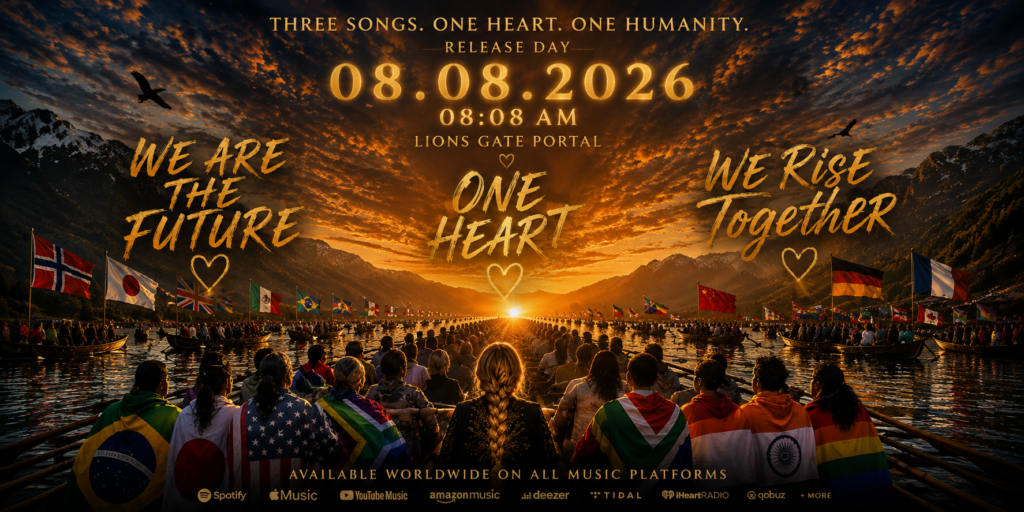
This is also why the three songs I am releasing this week—One Heart, We Rise Together, and We Are the Future—feel so synchronized with everything I am experiencing. They are not songs about escaping the reality we have created; they are invitations to participate differently within it. One Heart speaks to what remains beneath all our divisions. We Rise Together reminds us that transformation cannot become another individual achievement where a few people transcend while everyone else is left behind. And We Are the Future carries the most demanding message of all, because it removes the comforting idea that someone else is coming to create the world we long for. The future is not an abstract destination waiting somewhere ahead of us. It is being formed through the consciousness, choices, courage and relationships we embody now.
The old structures I encounter do not therefore make me hopeless. They show me where the work is. The resistance does not necessarily tell me to stop; sometimes it reveals precisely where a new possibility needs someone willing to remain present long enough to find it. At the same time, embodiment requires discernment, because not every wall is meant to be broken and not every battle is ours to fight. We cannot repair every institution, expose every injustice or carry every suffering person on our shoulders. That is another form of exhaustion. Our task is to listen closely enough to recognize where our own hands belong, where our own voice matters, where our own gifts can serve, and where life is genuinely asking us to step forward.
The Lion’s Gate portal I am interested in is the distance between knowing and living, because that may be one of the greatest distances a human being ever crosses. We know that love matters, yet we still divide. We know that people need dignity, yet we build systems where procedure can become more important than the person standing in front of us. We know that courage matters, yet fear still keeps many truths unspoken. We know that humanity is interconnected, yet we continue behaving as though another person’s suffering belongs to someone else. The opening we need may therefore not be somewhere in the heavens. It may be the opening through which what we already know finally enters our hands, our feet, our voices, our workplaces, our institutions and our everyday lives.
Embodying the future means becoming today what we keep asking tomorrow to deliver.
It means allowing spirituality to descend from concept into character, from vision into behavior, from meditation into service and from consciousness into the living body. It means being willing to see both the extraordinary beauty humanity is capable of and the terrible things we have created when we forget our connection to one another, without turning away from either. I do not believe we need more people waiting for the world to change before they begin living differently. I believe we need people willing to become small, living examples of the world they wish existed, right where they are, with whatever resources, influence, courage and love they have available.
The future does not need to arrive. It needs to be embodied.