
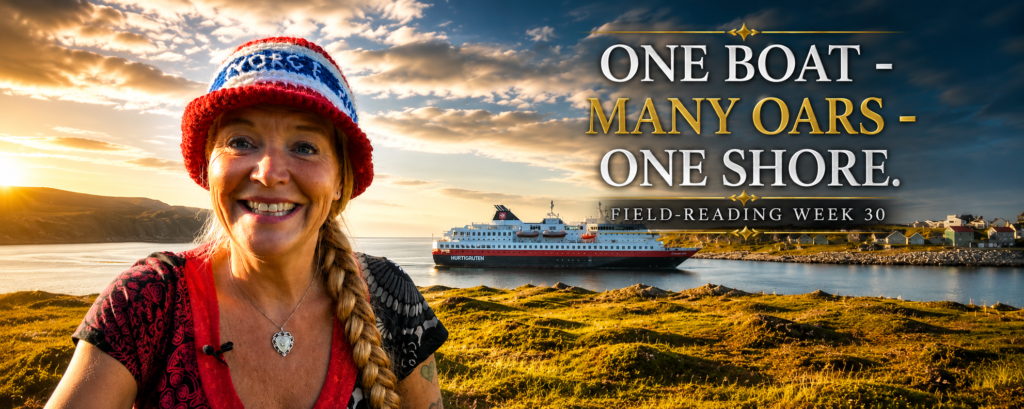
One Boat – Many Oars – One Shore: Field-Reading week 30
Last week I wrote about the extraordinary welcome home that Norway gave its national football team after the World Cup, and how that moment reminded me that the greatest victories are not always the ones that lift a trophy, but the ones that awaken something timeless within us. For a brief moment, hundreds of thousands of people seemed to forget competition and remembered instead what it feels like simply to belong. It was as though an entire nation stopped asking who had won and started remembering that we were already rowing in the same boat.
And yet, almost as soon as that remembrance arrived, another movement began to reveal itself. It was as though life quietly whispered, “If this is the world you long to create, then you must also be willing to meet everything within yourself that prevents it.” Throughout this week I have listened to story after story from people who are arriving at what I can only describe as a sacred threshold. They speak about reaching a point where something inside them simply says, “Enough.” Enough pretending that everything is fine. Enough remaining in workplaces that slowly diminish their spirit. Enough carrying relationships that have become obligations instead of living expressions of love. Enough adapting themselves to systems that no longer recognize their humanity. There is a quiet revolution taking place, one built upon honesty. And honesty has always been one of the purest forms of love.
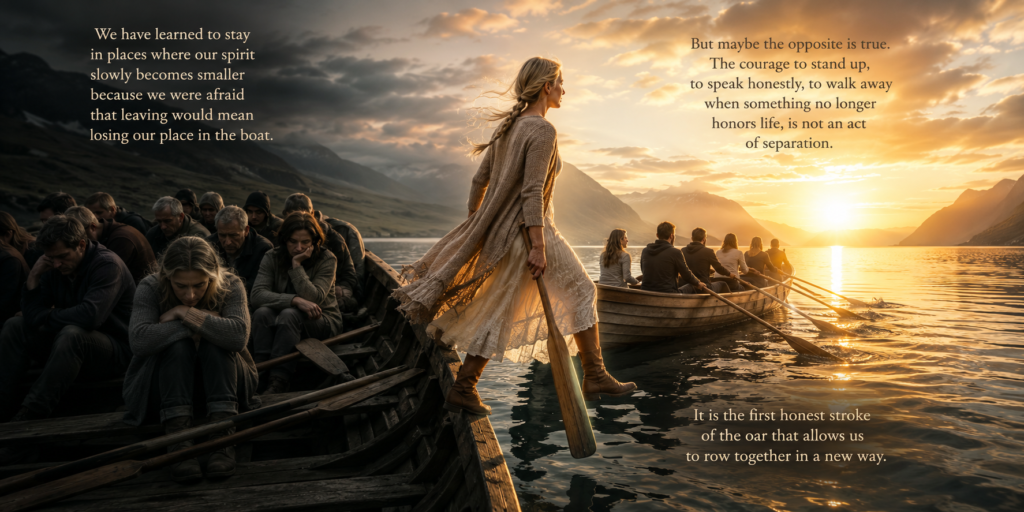
There is something profoundly different about the kind of “enough” I have been witnessing this week. It is not the “enough” that grows out of resentment or revenge, nor the kind that wishes to punish those who have caused pain. It is quieter than that, and perhaps because of its quietness it carries far greater strength. It is the moment when a human being can no longer betray their own soul in order to preserve an outer appearance of harmony. It is the moment when we realize that true peace has very little to do with avoiding conflict and everything to do with living in alignment with what love has been whispering to us all along. For years we have mistaken adaptation for belonging, silence for kindness, obedience for loyalty, and endurance for strength. We have learned to stay in places where our spirit slowly becomes smaller because we were afraid that leaving would mean losing our place in the boat. But maybe the opposite is true. The courage to stand up, to speak honestly, to walk away when something no longer honors life, is not an act of separation. It is the first honest stroke of the oar that allows us to row together in a new way.
As I have listened to people’s stories throughout this week, I have been struck by how similar they are beneath the surface. The details are always different. One person speaks about a workplace where fear has replaced trust. Another speaks about a marriage that has become an arrangement rather than a living relationship. Someone else speaks about parents they have spent an entire lifetime trying to please, or children they no longer know how to reach. On the surface these appear to be separate stories, but beneath them I hear the same question repeated again and again. How do I remain true to myself without losing my connection to those I love? I believe this is one of the defining questions of our time. Humanity longs for belonging more than almost anything else, yet we have often confused belonging with fitting in. We have learned to wear masks in order to be accepted, and then we wonder why we feel unseen. We have learned to silence our truth in order to preserve relationships, and then we wonder why our hearts slowly become heavy. The shadow is rarely the conflict itself. More often it is the part of us that believes we must abandon ourselves in order to be loved.
This is why I do not see the shadows that are surfacing around us as signs that humanity is moving backwards. On the contrary, I experience them as evidence that something deeper is awakening. Shadows only become visible when there is enough light to reveal them. For generations we have carried inherited patterns of fear, shame, silence, control and separation because they became woven into the fabric of our families, our institutions and our cultures. We inherited ways of surviving that once protected us, yet many of them no longer allow us to live fully. Now they are rising into our awareness to invite us into a deeper freedom. Every shadow that comes into the light carries the possibility of becoming wisdom, and every difficult conversation that is finally spoken with honesty creates a little more space for love to move between us.
This is also why our bodies seem to be speaking so loudly at the moment. In my own work I continue to meet people whose physical symptoms, exhaustion, anxiety, illnesses or emotional overwhelm often seem to tell a story that words have been unable to express. I have long experienced the body as an extraordinary intelligence, one that remains deeply loyal to life even when our conscious mind has forgotten how to listen. It does not speak in the language of blame. It speaks in the language of invitation. It slows us down when we have been running too fast. It asks us to rest where we have ignored our own limits. It reveals grief that has never been allowed to flow, anger that has never been acknowledged, and love that has waited patiently beneath layers of protection. I do not believe that every illness has a single explanation, nor that suffering should ever be simplified. But again and again I have witnessed how what first appeared to be an obstacle gradually became the doorway through which a person discovered a deeper relationship with themselves, with others and with life itself. Sometimes what we call healing begins not with removing the symptom, but with finally hearing what the symptom has been trying to say.
While I was recording this week’s video, standing by the sea with the Hurtigruten passing quietly behind me, something happened that touched me far more deeply than I expected. As I spoke about humanity learning to row together, about one boat, many oars and one shore, the ship suddenly sounded its horn across the fjord. It was only a few seconds, yet it moved something inside me that words struggle to describe. I felt tears rising before I had time to understand why. It was not because I imagined the ship was responding to me, nor because I needed to assign a mystical meaning to the moment. It was because something inside me recognized the symbolism before my mind could explain it. The sound echoed across the water like a reminder that we are living in a time of awakening, a time when humanity is being called to remember itself. In that moment I felt, more than I thought, that we are being invited to stop rowing against one another and begin rowing with one another. It felt less like an idea and more like a memory returning home.
This week I noticed that one of the songs I had shared, We Belong, had already been viewed by more than 60 thousand people on Instagram. My first response was not excitement about the number. Instead, I found myself wondering what it was that so many people had recognized in those few minutes of music. I do not think they were simply listening to a melody. I think they were responding to a longing that has always lived beneath the surface of human life. Every human being longs to belong. We long to know that we are welcome before we have achieved anything, before we have proven ourselves, before we have become successful, intelligent, spiritual or accomplished. We long to know that our place in the boat is not dependent upon our performance. Maybe that is why the song has travelled so quickly. It speaks to something older than language, older than culture and older than nationality. It reminds us that before we became citizens of different countries, members of different religions or holders of different opinions, we belonged to life itself. This is one of the deepest invitation of Week 30. Not simply to row harder, nor even to row better, but to remember why we picked up the oars in the first place. We row because we belong to one another, and when we remember that simple truth, the shore we have been searching for no longer feels impossibly distant. It begins to appear, quietly and faithfully, with every loving stroke we make together.