

Architecture of the Living Ethos – A Relational Framework for Life, Health, and Responsibility
Living the Architecture of Life
If The Architecture of Light explores the cosmological foundation of reality, and The Architecture of Future Medicine brings this understanding into the body, The Architecture of the Living Ethos takes the next step: it explores how this same architecture is lived in everyday life.
This book examines what it means to live as a relational being within a living universe. It asks how human choices, attitudes, language, and relationships influence not only society but also biology, health, and the wider field of life.
Rather than presenting a moral system or a set of rules, the book introduces the idea of a living ethos—a way of being that naturally arises when human beings recognize themselves as participants in the web of life.
In this view, ethics is not imposed from outside. It emerges from relationship.
Foreword (Excerpt)
This book is the third in a triad. All three books arise from the same foundation and point toward the same reality, approached from different and necessary levels of understanding.
The Architecture of Light described the cosmos and the structure of the field—what reality is composed of before the human being enters it.
The Architecture of Future Medicine brought this understanding into the body, exploring how the same architecture expresses itself biologically through regulation, coherence, and living systems.
The Architecture of the Living Ethos takes the third step. Not upward, but inward—into everyday life. It explores how this same architecture is lived through relationship, responsibility, and interaction with all that is alive.
A living ethos is not morality or ideology. It is a life orientation that arises when the human being recognizes itself not as an observer of life, but as a participant within it.
Professional readers Kathleen Scully and Colin Whitby share their reflections on The Architecture of Light, The Architecture of Future Medicine, and The Architecture of the Living Ethos — offering an in-depth perspective on the impact and depth of these works.
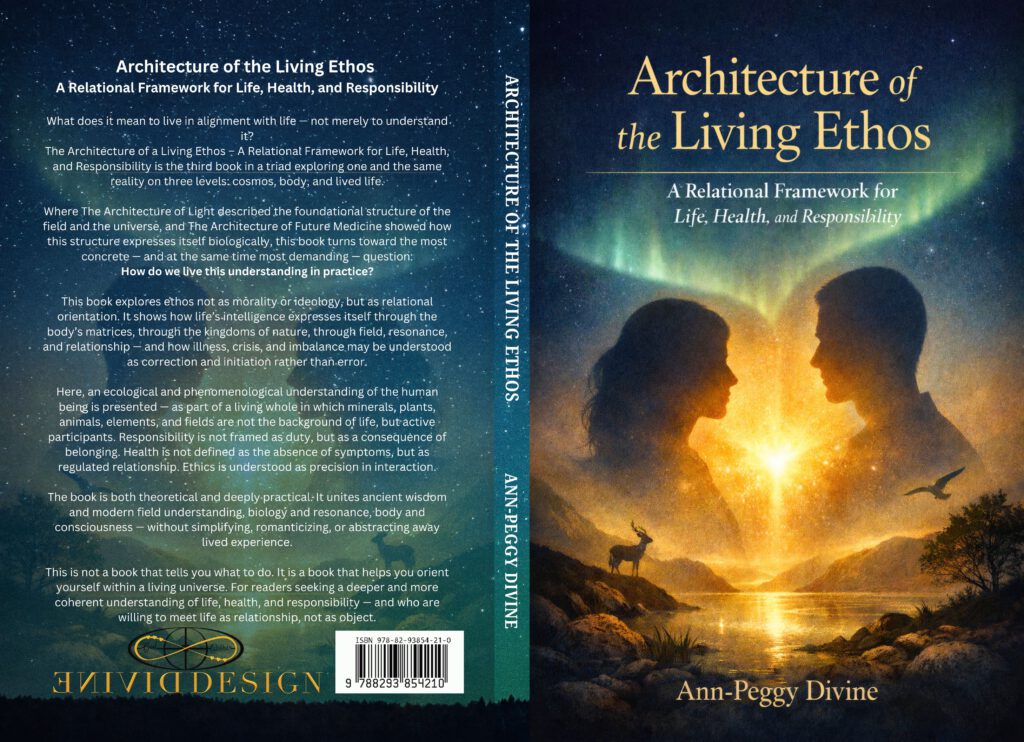
What This Book Explores
Through forty-four chapters, The Architecture of the Living Ethos develops a relational framework for understanding how human life unfolds within a living universe.
The book explores the idea that human beings are fundamentally relational—biologically, emotionally, socially, and ecologically. Our health, our perception, and our collective systems are deeply influenced by how we relate to the world around us.
The reader is introduced to the 13 Matrix system, which describes layers of relational intelligence within the body and the wider field of life. These matrices serve as organizing structures through which perception, regulation, and interaction take place.
From this foundation, the book expands into a broader exploration of the realms of life—including the mineral, plant, animal, human, elemental, and field dimensions of existence. Each of these realms is presented not as an abstract concept, but as a living participant within the relational architecture of Earth.
The later chapters explore how language, emotion, environment, sound, and vibration influence biological regulation and the atmosphere of human relationships.
Gradually, the reader is guided toward a deeper understanding of how everyday life itself becomes the place where coherence, responsibility, and participation in the living field unfold.
Themes in the Book
Within the pages of The Architecture of the Living Ethos, readers encounter themes such as:
- the shift from rule-based ethics to relational responsibility
- the human being as a fundamentally relational organism
- indigenous perspectives on relationship with nature
- the body as a sensing participant in a living universe
- the intelligence of the elements and the natural world
- the 13 Matrix architecture of human life
- communication between the realms of life
- the influence of attitude, language, and emotional climate on biology
- the role of environment and resonance in health and coherence
Rather than offering prescriptions for how life should be lived, the book reveals how life already operates through relationship, resonance, and participation.
A Relational Way of Being Human
The Architecture of the Living Ethos invites the reader to rediscover a deeper orientation toward life. In this orientation, illness may be understood as correction rather than punishment. Communication becomes relationship rather than transmission. Responsibility becomes participation rather than obligation.
Human beings are no longer seen as separate from the world around them, but as participants within a living field of intelligence that includes the body, the Earth, and the wider cosmos.
Living in alignment with this architecture does not require new belief systems. It requires attention, presence, and a willingness to enter into relationship with life itself.
Buy the Book
The Architecture of the Living Ethos — A Relational Framework for Life, Health, and Responsibility
This book is part of the Architecture Series by Ann-Peggy Divine, exploring the deeper architecture of consciousness, the living body, and the relational intelligence that connects humanity with the Earth and the wider cosmos.