
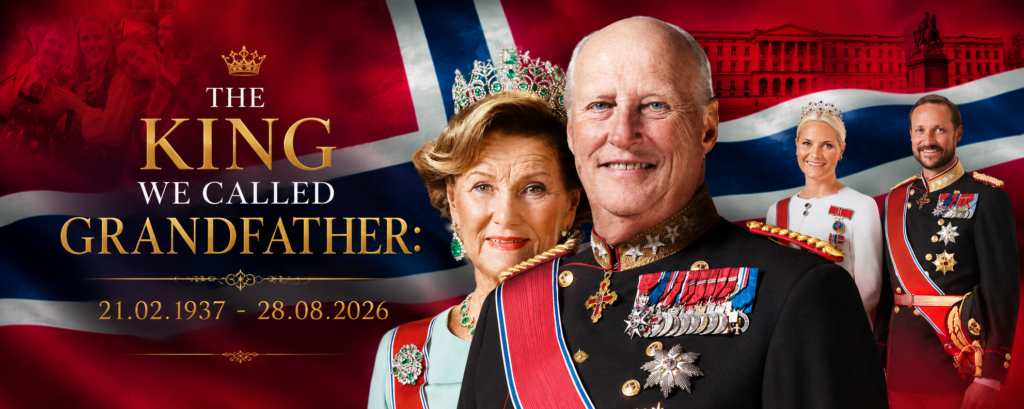
KING HARALD V OF NORWAY
The King Who Reminded Us Who We Are – 21 February 1937 – 28 August 2026
There are people whose importance cannot fully be understood through the position they held, the years they served, or the history books that will one day describe their lives. Their deeper legacy lives somewhere else, in the way people felt in their presence, in the words they left behind, in the values they quietly embodied, and in what they awakened in others simply by being who they were.
For me, King Harald V was such a person.
He was our King, but over the years he became something much closer to the Norwegian people than the word King can fully express. There was a warmth around him, a humility, humour and humanity that somehow shortened the distance between the Palace and ordinary life. He could carry the dignity of the Crown while still allowing us to see the man beneath it, and maybe this is why so many Norwegians came to speak of him with an extraordinarily affectionate name:
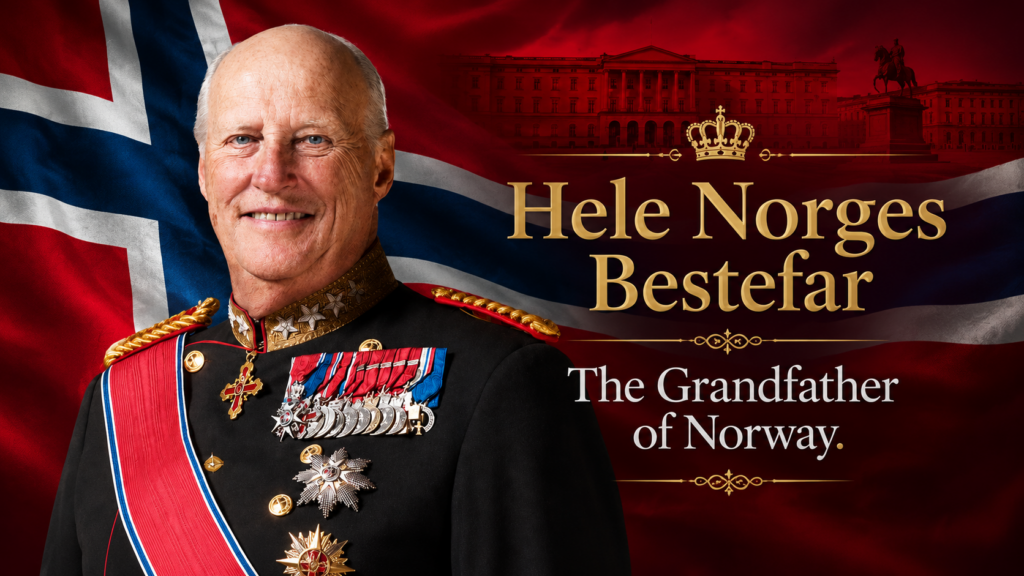
Hele Norges Bestefar — The Grandfather of Norway.
No constitution gave him that title, and no crown could have given it to him. It grew slowly through decades of relationship between a King and his people, and perhaps that is what makes it one of the most beautiful titles he ever carried.
THE MAN BEHIND THE CROWN
When I look back at King Harald’s speeches, what touches me most is not simply that he knew how to speak beautifully. It is the remarkable consistency in what he chose to speak about. Again and again, across decades, he returned to the human heart.
He spoke about compassion and dignity, about belonging and loneliness, about hope when life becomes dark, about listening to people whose lives are different from our own, about finding the courage to become who we truly are, and about the responsibility we carry for one another. This is what fascinates me when I read his words today. Beneath the speeches of a Head of State, there is something resembling a philosophy of being human. In 2002, he said:
“We must reintroduce the word compassion.”
Such a simple sentence, and yet more than two decades later it feels almost prophetic. What would happen to our societies if compassion were not regarded as weakness, but as one of the most sophisticated human capacities we possess? What would happen if we became more interested in understanding one another than defeating one another, and if we remembered that behind every position, identity, belief and disagreement there is still a human being trying to make sense of life?
King Harald kept bringing us back to that place.
HE REMINDED US OF OUR INHERENT WORTH
One of the deepest threads I find in King Harald’s words is his insistence on the value of the individual human being. He once said:
“Each and every one of us has infinite value.”
And years later he spoke about something precious that every human being carries within:
“We all carry something precious inside us that is ours alone.”
He described it as an inner compass, something that cannot simply be taken away from us.
I find this profoundly beautiful because it speaks about human worth before achievement, status, success or recognition. It says that there is something within a human being that precedes all the roles we accumulate throughout a lifetime.
King Harald understood this particularly well because his own role was decided long before he could choose it. He was born into history. He was born into responsibility. He would eventually carry one of the most defined roles any human being can carry, and yet he said something that reaches far beyond monarchy:
“It is the person who fills the role that matters.”
I keep returning to those words. Because eventually every title disappears. King. Queen. Priest. Teacher. Mother. Father. Leader. Doctor. Artist. What remains is the human being who inhabited the role, and what that human being brought into the lives of others.
BECOMING WHO WE WERE BORN TO BE
There is another statement from King Harald that I find almost astonishing in its depth:
“It is up to each of us to become who we were born to be.”
He spoke about questioning the ideals and expectations placed upon us and finding the courage to ask whether the life we are living is actually true for us. For me, these words reach into something fundamental about human existence.
We spend so much of our lives becoming what the world expects us to become that we can forget to listen for what is already alive within us. Family, culture, education, institutions and society continuously tell us who we should be, what success should look like and what kind of life is acceptable. Yet somewhere underneath all of this is the quieter question:
Who was I actually born to be?
I find it deeply meaningful that a King, a man born into duty and tradition, repeatedly invited ordinary people to listen to that inner compass.
NORWAY IS, ABOVE ALL, PEOPLE
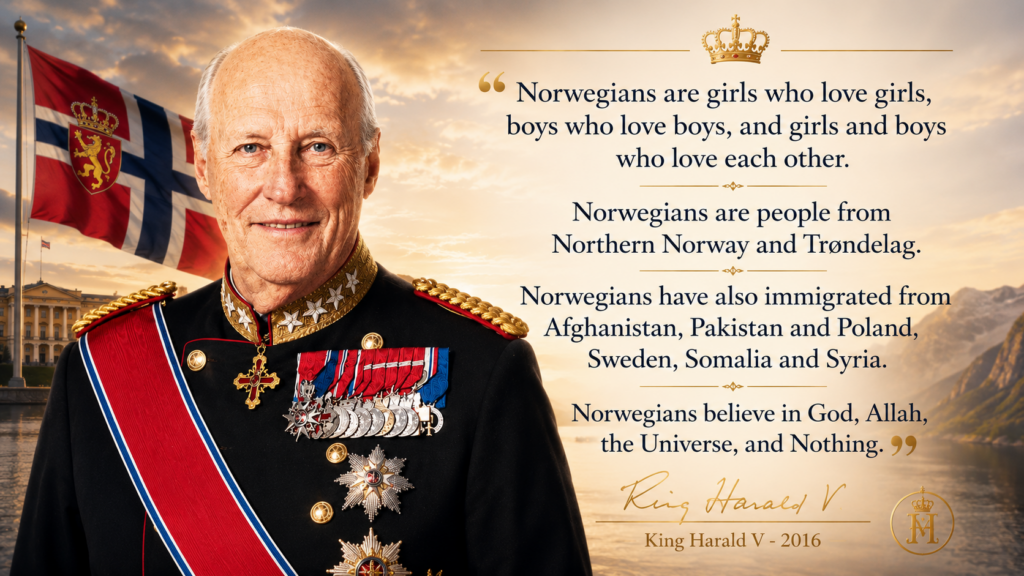
Maybe no speech captured King Harald’s understanding of Norway more beautifully than his speech in the Palace Park in 2016. He spoke about our mountains and fjords, our coastline, our seasons and our geography, but then he moved beyond all of it and said:
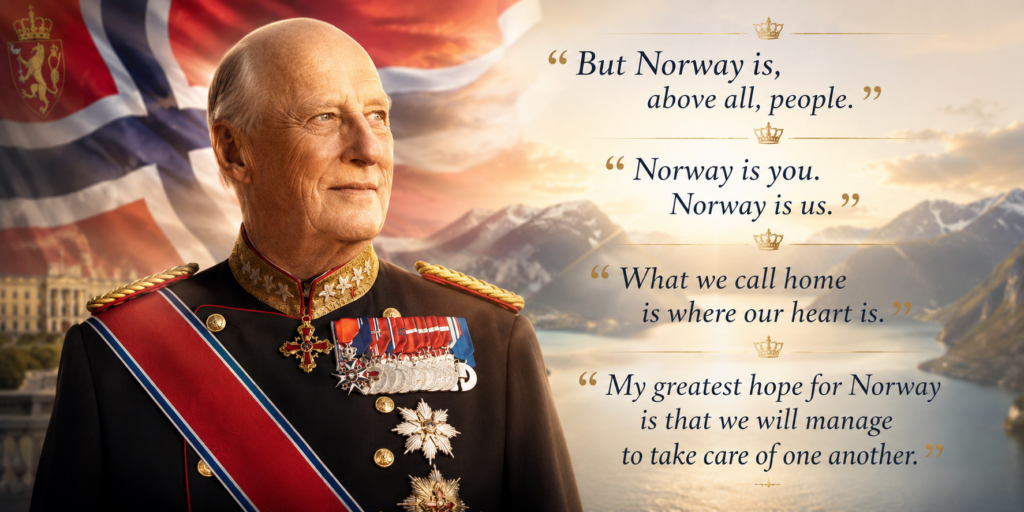
“But Norway is, above all, people.”
He described a Norway containing different cultures, different beliefs, different ways of loving and different ways of living. He spoke of Norwegians who believe in God, Allah, the Universe and Nothing, and somehow managed to make room for all of them inside the same understanding of home. Then came the words that would become some of the most remembered of his reign:
“Norway is you. Norway is us.”
There is something about those words that I believe reaches far beyond Norway. A nation is not ultimately its buildings, institutions, borders or symbols. A nation is a living relationship between human beings, carried from one generation to another. King Harald understood belonging in this deeply human way when he said:
“What we call home is where our heart is.”
And the sentence that most clearly reveals the Norway he hoped we would become was this:
“My greatest hope for Norway is that we will manage to take care of one another.”
Not that we would become the richest, that we would become the most powerful or that everyone would agree. But that we would manage to take care of one another. There is an entire vision of society contained within that sentence.
FROM I TO WE
When I look across King Harald’s words through the years, I see one movement appearing again and again, and I believe this may be one of the deepest parts of his legacy. It is the movement from I to We. In his 2009 New Year’s speech, he introduced an African understanding that carries the essence of Ubuntu:
“I am because we are. Because we are, I am.”
I find it remarkable that these words appeared in a Norwegian King’s address to his people, because they express something humanity so easily forgets: none of us becomes human alone. Our lives are woven into other lives. Someone held us when we were small. Someone taught us language. Someone grew our food, built our roads, cared for us when we were ill, challenged us, loved us, disappointed us, forgave us and helped shape the person we eventually became. Even the person who believes they stand completely alone is standing upon an invisible architecture of relationships.
King Harald returned to this understanding throughout his reign, and in his later years he spoke explicitly about the movement “from an I to a We.”
That movement is more important now than ever. Because we live in a time when so many forces encourage separation. We divide ourselves according to politics, religion, nationality, identity, generation, wealth and worldview, and gradually we can begin to experience the person on the other side as an abstraction rather than a human being. King Harald continually brought the conversation back to something simpler and deeper:
We need each other.
WHEN NORWAY WENT DARK
There are moments when leadership is no longer about ceremony, representation or tradition. There are moments when a nation is wounded and needs someone who can stand inside the grief without pretending to have an answer for it. For Norway, 22 July 2011 was such a moment. When terror struck Oslo and Utøya, King Harald did not try to make the darkness smaller than it was. He stood with a nation that was shocked, grieving and afraid, and said:
“I hold firmly to the belief that freedom is stronger than fear.”
Ten years later, when Norway remembered those who were killed, he returned to the darkness once again:
“Ten years have passed since Norway was darkened. But many are shining.”
I find those words extraordinary because they reveal something about the kind of hope he carried. It was not a hope that denied suffering. It was a hope capable of looking directly at suffering and still asking:
Where is the light now? Who is carrying it? What can still grow from what has been broken?
King Harald stood with Norway when Norway grieved. And when his own life came to an end, Norway stood together and grieved for him. There is something profoundly moving in that circle.
THE HEART
The word that comes closest to what I personally recognise in King Harald’s legacy is heart. In his 2018 New Year’s speech, he reflected upon the ancient words:
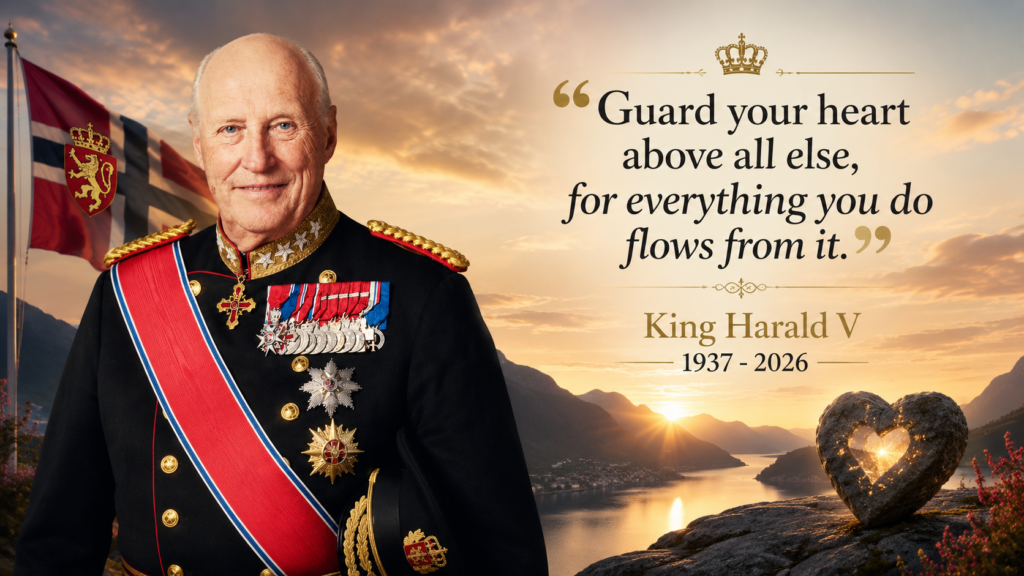
“Guard your heart above all else, for everything you do flows from it.”
He then brought this wisdom into ordinary human life by speaking about kindness, respect, lifting others up and recognising a fellow human being in someone who initially appears foreign to us. This is where great ideas become real.
Compassion is beautiful as a concept, but it means very little until there is a human being standing in front of us whom we find difficult to understand. Love is beautiful as an ideal, but it becomes real through the way we speak, listen, forgive, include and care. Human dignity sounds magnificent in speeches, but its truth is revealed in how we treat the person who has nothing to offer us in return.
King Harald seemed to understand this. And he kept reminding us.
WHAT HE TAUGHT WITHOUT WORDS
Yet I do not believe King Harald’s influence can be understood only through his speeches. There was also something in his way of being. The humour and that unmistakable glimmer in his eye, the ability to carry dignity without becoming distant, the warmth with which he met ordinary people and the increasing vulnerability he allowed Norway to witness as he grew older all communicated something that words alone could not.
He showed us that authority does not have to become coldness, that dignity does not require distance, and that strength and vulnerability can inhabit the same human being. We did not only see a King performing the role of King. Over the years, we were allowed to see Harald. And somewhere in that meeting between the institution and the human being, affection grew.
THE GRANDFATHER OF NORWAY
This is why I keep returning to the name so many people used for him: Hele Norges Bestefar – The Grandfather of Norway.
There is something almost impossible about such a description of a monarch, because grandfather belongs to the language of family rather than power. A grandfather sits closer to us than a throne does. A grandfather carries stories and memories from before we were born. He represents continuity between generations. There can be wisdom, humour, imperfection, warmth and the strange comfort of simply knowing that he is there.
For generations of Norwegians, Harald was simply there. Children became adults while he was King, and those adults had children who grew up seeing the same familiar man waving from the Palace balcony. That is why his death touched something deeper than the loss of a Head of State. Something familiar disappeared from the Norwegian landscape. Someone who had accompanied us through our collective life was suddenly no longer there.
ALT FOR NORGE
Throughout his reign, King Harald carried the royal motto:
ALT FOR NORGE — ALL FOR NORWAY
Those three words take on a different meaning when viewed at the end of a life devoted to service. And the most beautiful response we can offer him now is not simply to remember him, but to carry forward some of what he spent decades reminding us about.
To listen when it would be easier to judge.
To remain curious about someone whose life is different from our own.
To recognise the infinite value of another human being.
To protect the heart from becoming hardened.
To choose hope without denying darkness.
To remember that home is ultimately created through belonging.
To move, whenever we are able, from I to We.
And to take care of one another.
This is how a legacy truly survives. Not as words engraved in stone, but as values becoming alive in other human beings. King Harald once gave his life to the words:
Alt for Norge.
And now, from my heart, and together with so many who loved him, I want to answer:
Takk for alt, Kong Harald.
Thank you for your warmth, your humour and your humanity. Thank you for standing with Norway in our celebrations and in our deepest grief, for reminding us that every human being has value, and for showing us that the greatness of a role will always depend upon the humanity of the person who carries it. You were born a Prince. You became our King. And somewhere through all those years, you became something no Crown could ever have made you:
The Grandfather of Norway
Hele Norges Bestefar
May we honour you not only by remembering who you were, but by becoming more of what you spent a lifetime reminding us that we could be.
His Majesty King Harald V of Norway
21 February 1937 – 28 August 2026
Alt for Norge.
Takk for alt.