
Living with Patience — Field-Reading – Week 22
There are certain weeks where a theme announces itself loudly through events and circumstances, and then there are weeks where a quality reveals itself quietly, almost imperceptibly, until you suddenly realize that it has been present everywhere around you. Week 22 was such a week. The word that kept returning, whether through my own experiences, the conversations I had with friends and colleagues, the stories people shared about their lives, or even through the natural world itself, was patience.
What became increasingly clear throughout the week was that patience is often misunderstood. Many people associate patience with waiting, postponing action, or passively enduring something difficult until life eventually changes. Yet what I observed this week pointed toward something entirely different. Patience is not passive. It is not resignation. It is not the absence of movement. Rather, patience appears to be a deeply embodied state in which we become capable of remaining present with life exactly as it is, without needing to force it into becoming something else.
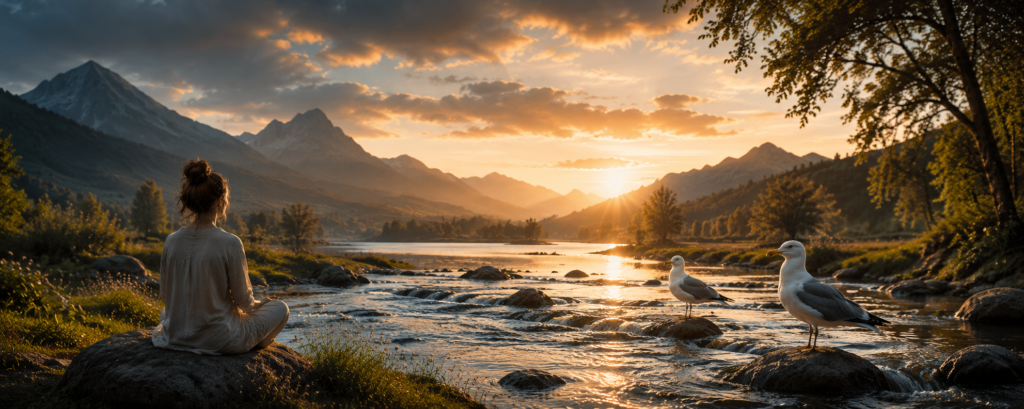
Perhaps the most beautiful mirror of this came through the seagulls that gather in the Jægervatnet river near my home. Every morning when I walk past the river they are there, standing in the flowing water and watching attentively. When I return many hours later, they are often still there. The river has continued its movement, the fish have continued their movement, the weather may have changed several times, and yet the seagulls remain. They are not distracted by the fact that the fish has not appeared yet. They are not frustrated because the river is taking longer than expected. They are not questioning whether they should abandon their position and search elsewhere. Instead, they embody a remarkable form of trust, attentiveness, and presence that allows them to remain available to the moment when life finally offers what they are waiting for.
As I watched them, I found myself wondering whether patience is less about waiting for the future and more about remaining fully available to the present. The seagulls are not sitting in the river dreaming about tomorrow’s fish. Their attention remains rooted in what is happening now. Their patience is not a mental strategy. It is a state of being.
This understanding deepened further when I reflected on a story I shared in this week’s video about a six-year-old girl attending a wedding ceremony. During the ceremony, a woman began to sing, and the little girl became deeply moved. Tears streamed down her face as she listened, not because she was sad, but because something within her was profoundly touched by the beauty of the music. What struck me was how rare such openness has become among adults. Most adults hear music, appreciate it intellectually, perhaps even enjoy it, yet very few allow themselves to be entered by it in the way this little girl did. Her entire being received the experience.
The more I contemplated this, the more I realized that such openness requires patience. To be touched deeply by life, we must remain present long enough for life to actually reach us. We must breathe deeply enough for beauty to enter the body rather than merely pass through the intellect. We must slow down enough for experience to move through our emotional and sensory systems instead of immediately categorizing, analyzing, or explaining it. In many ways, patience is what allows experience to become embodied.
This is perhaps why patience feels so connected to breath. Throughout the week I found myself returning repeatedly to the observation that patient people tend to breathe differently. Their breathing moves deeper into the abdomen. Their nervous systems are less reactive. Their bodies are not constantly preparing for the next problem, the next deadline, or the next outcome. Instead, there is a certain spaciousness inside them, a willingness to inhabit the present moment fully, even when the future remains uncertain. Patience therefore becomes much more than a virtue. It becomes a physiological state that affects how we regulate, how we perceive, how we relate, and ultimately how we live.
Another interesting synchronicity during Week 22 was the release of the Divine Design Podcast episode about Buddhism and the remarkable life of Lama Ole Nydahl. Although the conversation focused on meditation, Buddhism, and the transmission of ancient wisdom into modern life, I found myself realizing that much of what we discussed was also a reflection of patience itself. Meditation is, in many ways, the practice of embodied patience. It is the willingness to sit with life exactly as it is, without constantly demanding that it become something else. Through meditation, we gradually learn to remain present with our thoughts, emotions, sensations, and experiences without immediately reacting, escaping, fixing, or controlling them. Over time, this develops a deeper stability within the nervous system and a greater capacity to trust life’s unfolding process.
Listening to the life story of Lama Ole also reminded me that the deepest transformations rarely happen overnight. The path of awakening is not built through urgency, but through thousands of small moments of presence, practice, observation, and embodiment. In this sense, Buddhism and patience are deeply intertwined because both invite us to trust that growth unfolds according to a rhythm far older and wiser than the impatient demands of the mind. Perhaps this is why meditation has survived for thousands of years, not because it teaches us how to escape life, but because it teaches us how to remain present long enough to fully receive it.
For those interested in exploring this theme further, I highly recommend this week’s Divine Design Podcast, where we dive into Buddhism, meditation, and the extraordinary journey of Lama Ole Nydahl, whose life beautifully illustrates what becomes possible when patience, presence, and purpose are allowed to mature over time.