
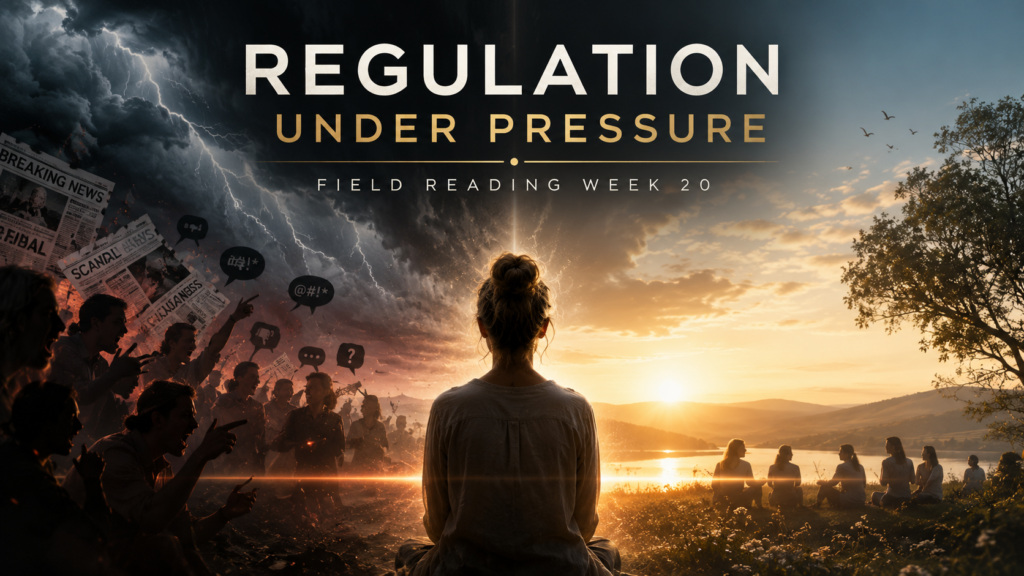
Regulation Under Pressure — Field-Reading - Week 20
This week revealed something that has become increasingly visible across groups, organizations, workplaces, communities, families, and larger social structures, namely how many human beings are currently living under emotional and nervous-system pressure that they no longer fully know how to contain, regulate, or consciously relate to. What became especially visible was not only the conflicts themselves, but the way people reacted inside the conflicts, because in several large collective situations I observed this week, certain individuals responded with intense emotional reactivity, anger, accusations, criticism, hostility, and statements that were clearly spoken from dysregulation rather than grounded reflection.
What was especially striking was how quickly these emotional eruptions spread into larger collective fields. Conversations expanded rapidly throughout the population, newspapers and media platforms amplified the conflicts, and public discussions became increasingly polarized, emotional, and reactive. Entire narratives formed around disagreement, blame, and criticism, and yet underneath all of this, something deeper appeared to be unfolding. The visible conflict itself was not actually the core issue. The deeper issue was regulation. The deeper issue was what happens when human beings and collective systems have carried unresolved emotional pressure for so long that the nervous system eventually begins leaking its accumulated tension into the relational field.
One of the clearest things I observed this week was the split that gradually emerged after the emotional eruptions themselves. Some individuals began reflecting upon their own reactions, apologizing, softening, and recognizing that certain responses had not been healthy or constructive. Others, however, seemed unable to move toward reflection or relational repair. Instead of softening, they reinforced their anger, defended their reactions more intensely, and continued amplifying the same emotional energy. It became possible to clearly observe two different trajectories unfolding side by side. One movement sought regulation, openness, reflection, and relational restoration, while the other remained locked inside pride, anger, defense, and emotional escalation.
What also became visible through the media coverage itself was that many of the situations that initially appeared extremely harsh, reactive, and polarized gradually began moving toward greater balance over time. The narratives became more nuanced. More perspectives entered the conversation. Emotional intensity slowly softened. Reflection began replacing immediate reaction. This revealed something important, because what we are witnessing collectively right now may not primarily be societal collapse, but emotional backlog surfacing into visibility so that it can finally be processed, seen, and reorganized.
This is why I do not see all this conflict as purely negative. In many ways, what is surfacing is necessary. Human beings cannot continue carrying enormous amounts of unresolved emotional tension, suppressed anger, accumulated frustration, nervous-system overload, grief, fear, and relational fragmentation without it eventually entering expression. Much of humanity has learned intellectual understanding without learning emotional regulation. Many people know how to speak about awareness, ethics, spirituality, psychology, or consciousness conceptually, while their nervous systems remain deeply dysregulated underneath the surface. The mind may appear coherent while the emotional body remains overloaded, fragmented, and reactive.
This is one of the reasons why emotional reactions currently seem disproportionate to the actual situations themselves. The reaction is often not only about the immediate event. It is the release of accumulated emotional pressure that has been building for years inside individuals, families, organizations, and entire societies. Under pressure, unresolved emotional material rises toward the surface, and this week made that impossible to ignore.
At the same time, this week also revealed something deeply hopeful, because regulation is possible. Human beings are not trapped forever inside their past conditioning, emotional reactivity, or nervous-system fragmentation. One of the strongest examples of this became visible through the launch of the Divine Design Podcast episode with Brett Robey titled “He Left Organized Crime… Then Accidentally Built a Prototype for the Future.” Brett’s life story reflects precisely the type of transformation this Field-Reading points toward. He moved from a life deeply connected to organized crime, anger, violence, survival, and emotional dysregulation into a completely different orientation toward life through fatherhood, meaning, responsibility, and self-confrontation.
What transformed Brett was not intellectual theory alone. It was the willingness to face himself honestly and begin regulating the unresolved emotional structures he had previously lived inside. When life gained deeper meaning, a different nervous-system orientation became possible. Instead of continuing to project pain outward through destruction, anger, and violence, he gradually reorganized his life through responsibility, reflection, fatherhood, and emotional transformation. In many ways, Brett now represents a prototype for something humanity deeply needs, namely men and fathers who are willing to confront their own dysregulation instead of unconsciously transmitting it into families, communities, and society itself.
This also reveals something essential about the larger evolutionary movement humanity is currently moving through. Regulation is not merely psychological. It is biological, emotional, relational, energetic, and collective at the same time. Human beings regulate each other continuously through tone of voice, nervous-system state, emotional presence, safety, touch, communication, openness, and relationship. When individuals remain chronically dysregulated, entire relational systems become unstable. Families become unstable. Organizations become unstable. Communities become unstable. Nations become unstable.
Yet the opposite is also true. As human beings begin developing greater emotional honesty, nervous-system awareness, self-reflection, accountability, and relational openness, coherence begins emerging naturally within the larger field around them. Regulation creates relational safety. Regulation creates trust. Regulation creates the conditions necessary for genuine communication and human connection.
This is deeply connected to what I describe as Divine Design, because Divine Design points toward a way of living where the human being is no longer fragmented between intellect, emotion, body, nervous system, and relational life, but gradually becomes more integrated and coherent across all levels of being. In this sense, emotional regulation is not suppression. It is not emotional control. It is the capacity to consciously remain present with what arises internally without unconsciously projecting it outward into destruction, blame, or reactive behavior.
Perhaps this is also part of what it means to evolve toward Homo Luminous, because the next stage of human development cannot emerge through intellectual advancement alone. Humanity must also mature emotionally, relationally, and biologically. We are now witnessing what happens when unresolved emotional material begins surfacing collectively under pressure, and although this process can appear chaotic and uncomfortable, it may also be part of a larger rebalancing process that humanity desperately needs.
What this week ultimately revealed is that many people are no longer able to hide their dysregulation behind intellect, social roles, spiritual language, professional identity, or collective positioning. Under pressure, the nervous system eventually speaks. The question is not whether unresolved material will surface, but whether human beings are willing to face what surfaces honestly enough for regulation, healing, and transformation to actually occur.