
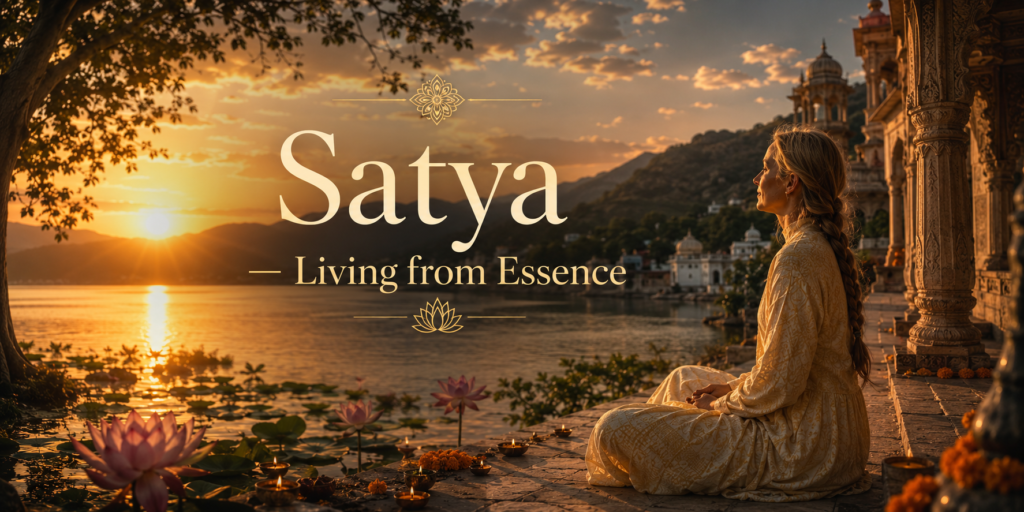
Satya — Living from Essence — Field-Reading - Week 19
This week carried a very different atmosphere and frequency than the weeks before, and the word that gradually revealed itself as the essence of the field was Satya, a being-word and oversoul-key connected to India. Satya is often translated simply as “truth,” although the deeper meaning of Satya points toward something far more profound than factual correctness or intellectual understanding. Satya refers to truth as lived alignment, truth as essence, and truth as the natural coherence that emerges when a human being is no longer organizing themselves primarily through performance, pressure, inherited identities, or adaptation to external expectations, but instead begins to live in deeper relationship with their own essence and inner architecture.
I began Week 19 by channeling and entering the field of India, and almost immediately something shifted within my own system. A profound calm, softness, openness, and clarity entered the week, and this state continued unfolding day after day in a way that felt deeply nourishing and deeply human at the same time. Rather than experiencing movement through pressure, striving, overthinking, or constant productivity, the week unfolded through presence, relationship, embodiment, and a grounded form of gratitude that seemed to arise naturally from simply being fully present within life itself.
At the center of this week was the celebration of my husband’s 55th birthday, where our core family gathered together for what had originally been planned as a surprise celebration a few days before his actual birthday. Adult children arrived unexpectedly, and what unfolded became one of the most beautiful and meaningful family experiences we have shared together. There was no pressure to create perfection, no need for performance, and no attempt to force emotional moments or orchestrate closeness. Instead, we simply allowed ourselves to be together exactly as we are, with all our uniqueness, sensitivity, humor, and rhythms. Perhaps this is one of the clearest lived expressions of Satya itself, because essence can only emerge where human beings feel safe enough to stop performing.

Throughout the week we cooked beautiful meals together at home, shared conversations, rested, laughed, and also enjoyed time together outside the home at restaurants and in different environments. Beneath all these experiences there was an underlying feeling that life itself had softened into something more natural and coherent. I also gave massage to all my children during the week, something they deeply enjoy and naturally seek, and even this became part of the field itself. Touch, care, physical closeness, and nervous-system regulation are all part of embodied truth. Satya is therefore not an abstract spiritual concept disconnected from ordinary life, but something profoundly practical and human that reveals itself through presence, relationship, care, embodiment, and the ability to remain emotionally available within the simplicity of everyday experiences.
What became increasingly visible this week is how exhausted many human beings have become from living too far away from their own essence. So much energy is spent maintaining identities, defending mental positions, adapting to collective expectations, or performing versions of ourselves that have gradually become disconnected from our deeper truth. Over time this fragmentation creates tension within both the nervous system and the relational field around us. Satya dissolves much of this tension because it does not ask us to perform truth, defend truth, or intellectually master truth. Instead, Satya invites the human being into alignment with what is already deeply true beneath the layers of conditioning, fear, and social adaptation. When this alignment begins to stabilize, the body softens, relationships become more authentic, perception sharpens, and life itself begins reorganizing in a more coherent way.
This is deeply connected to what I describe as Divine Design, because Divine Design points toward the understanding that there exists a deeper living architecture within the human being and within life itself. It is an intelligence that naturally emerges when we stop organizing ourselves primarily through fear, inherited scripts, social fragmentation, and externally imposed identities. In many ways, this is also connected to what I describe as the emergence of Homo Luminous, not as a perfected or superior human being, but as a human being who increasingly lives from essence rather than performance, from coherence rather than fragmentation, and from direct embodied knowing rather than borrowed intellectual structures.
As I entered the field of India this week, I could also feel very strongly how India carries a deep remembrance of gnosis and direct spiritual experience. India holds ancient traditions connected to meditation, consciousness, embodiment, direct perception, inner awakening, and the relationship between the human being and the divine. Many of these traditions were never originally rooted in belief alone, but in lived experience and direct realization. In this sense, Satya is deeply connected to gnosis because both point toward truth as something embodied and experienced rather than something merely inherited through doctrine or intellectual interpretation.
At the same time, every civilization carries both light and shadow, and one of the shadows that also became visible this week was the caste system within India. The caste system reflects a form of separation and hierarchy that mirrors many of the same mechanisms found within racism. Racism is not only about skin color itself, but about the mental construction of human value based on external identity and inherited social structures. This was also part of the continuation from Week 18, where the distinction between embodied gnosis and mental scripting became so visible. Whether separation happens through race, class, caste, religion, or ideology, the deeper mechanism is often the same, because the mind attempts to organize human value externally rather than perceiving the deeper shared essence that exists beneath surface identity.
Another important aspect of this week was the experience of expansion within my own perception and life movement. I had meaningful conversations with inspiring people, explored future possibilities, and made plans connected both to the coming summer and to the study year of 2027, while at the same time feeling that several new environments and life phases are beginning to open naturally. Some of these changes will begin within the next month, while others are connected to the coming year. Yet what felt most important was not the plans themselves, but the quality through which they emerged. There was no feeling of force, pressure, panic, or urgency. Instead, there was flow, timing, balance, and a deeper trust in life’s own intelligence. This too feels deeply connected to Satya, because Satya does not remove movement or transformation from life, but changes the quality through which movement occurs.
One of the strongest experiences connected to this week was also gratitude, not as a mental practice or spiritual technique, but as a natural state that emerges when fragmentation begins to quiet within the human being. When life is no longer constantly filtered through fear, lack, comparison, pressure, or performance, something much simpler and more profound begins to appear, namely the ability to truly experience and receive what is already here. Gratitude in this sense is not forced positivity, but a direct consequence of coherence, embodiment, relationship, and presence.
Perhaps this is also one of the deepest meanings of Satya itself, because Satya ultimately points toward the remembrance that truth is not something distant that must be intellectually acquired from the outside, but something that gradually reveals itself as we become more present within our own lived experience. It is the quiet return to essence beneath conditioning and fragmentation, and perhaps this is also what gnosis ultimately reveals, namely that truth is not merely something we think about, discuss, or believe in, but something that can be lived through the body, through relationship, through perception, through presence, and through the sacred simplicity of being fully here within life itself.